Monday, July 17, 2017

Adam Smith Meets Joseph Campbell

Campbell wrote the book The Hero With a Thousand Faces, which was one of the inspirations for Star Wars. He was interviewed by Bill Moyers in a six hour series in the 1980s on PBS. That series was called The Power of Myth.

Here is one passage:
"“This is the threat to our lives that we all face today. Is the system going to flatten you out and deny you your humanity, or are you going to be able to make use of the system to the attainment of human purposes? How do you relate to the system so that you are not compulsively serving it? It doesn't help to try to change it to accord with your system of thought. The momentum of history behind it is too great for anything really significant to evolve from that kind of action. The thing to do is learn to live in your period of history as a human being. That's something else, and it can be done.”"
Here is another:
"The world is a wasteland. People have the notion of saving the world by shifting it around and changing the rules and so forth. No, any world is a living world if it’s alive, and the thing is to bring it to life. And the way to bring it to life is to find in your own case where your life is, and be alive yourself, it seems to me."
Adam Smith said something that seemed similar in his book The Theory of Moral Sentiments:
"The natural course of things cannot be entirely controlled by the impotent endeavours of man: the current is too rapid and too strong for him to stop it; and though the rules which direct it appear to have been established for the wisest and best purposes, they sometimes produce effects which shock all his natural sentiments."
Smith also seems to be hinting at the law of unintended consequences. Here is a longer excerpt to see the context:
"But though the general rules by which prosperity and adversity are commonly distributed, when considered in this cool and philosophical light, appear to be perfectly suited to the situation of mankind in this life, yet they are by no means suited to some of our natural sentiments. Our natural love and admiration for some virtues is such, that we should wish to bestow on them all sorts of honours and rewards, even those which we must acknowledge to be the proper recompenses of other qualities, with which those virtues are not always accompanied. Our detestation, on the contrary, for some vices is such, that we should desire to heap upon them every sort of disgrace and disaster, those not excepted which are the natural consequences of very different qualities. Magnanimity, generosity, and justice, command so high a degree of admiration, that we desire to see them crowned with wealth, and power, and honours of every kind, the natural consequences of prudence, industry, and application; qualities with which those virtues are not inseparably connected. Fraud, falsehood, brutality, and violence, on the other hand, excite in every human breast such scorn and abhorrence, that our indignation rouses to see them possess those advantages which they may in some sense be said to have merited, by the diligence and industry with which they are sometimes attended. The industrious knave cultivates the soil; the indolent good man leaves it uncultivated. Who ought to reap the harvest? who starve, and who live in plenty? The natural course of things decides it in favour of the knave: the natural sentiments of mankind in favour of the man of virtue. Man judges, that the good qualities of the one are greatly over-recompensed by those advantages which they tend to procure him, and that the omissions of the other are by far too severely punished by the distress which they naturally bring upon him; and human laws, the consequences of human sentiments, forfeit the life and the estate of the industrious and cautious traitor, and reward, by extraordinary recompenses, the fidelity and public spirit of the improvident and careless good citizen. Thus man is by Nature directed to correct, in some measure, that distribution of things which she herself would otherwise have made. The rules which for this purpose she prompts him to follow, are different from those which she herself observes. She bestows upon every virtue, and upon every vice, that precise reward or punishment which is best fitted to encourage the one, or to restrain the other. She is directed by this sole consideration, and pays little regard to the different degrees of merit and demerit, which they may seem to possess in the sentiments and passions of man. Man, on the contrary, pays regard to this only, and would endeavour to render the state of every virtue precisely proportioned to that degree of love and esteem, and of every vice to that degree of contempt and abhorrence, which he himself conceives for it. The rules which she follows are fit for her, those which he follows for him: but both are calculated to promote the same great end, the order of the world, and the perfection and happiness of human nature.

But though man is thus employed to alter that distribution of things which natural events would make, if left to themselves; though, like the gods of the poets, he is perpetually interposing, by extraordinary means, in favour of virtue, and in opposition to vice, and, like them, endeavours to turn away the arrow that is aimed at the head of the righteous, but to accelerate the sword of destruction that is lifted up against the wicked; yet he is by no means able to render the fortune of either quite suitable to his own sentiments and wishes. The natural course of things cannot be entirely controlled by the impotent endeavours of man: the current is too rapid and too strong for him to stop it; and though the rules which direct it appear to have been established for the wisest and best purposes, they sometimes produce effects which shock all his natural sentiments. That a great combination of men should prevail over a small one; that those who engage in an enterprise with forethought and all necessary preparation, should prevail over such as oppose them without any; and that every end should be acquired by those means only which Nature has established for acquiring it, seems to be a rule not only necessary and unavoidable in itself, but even useful and proper for rousing the industry and attention of mankind. Yet, when, in consequence of this rule, violence and artifice prevail over sincerity and justice, what indignation does it not excite in the breast of every human spectator? What sorrow and compassion for the sufferings of the innocent, and what furious resentment against the success of the oppressor? We are equally grieved and enraged at the wrong that is done, but often find it altogether out of our power to redress it. When we thus despair of finding any force upon earth which can check the triumph of injustice, we naturally appeal to heaven, and hope, that the great Author of our nature will himself execute hereafter, what all the principles which he has given us for the direction of our conduct, prompt us to attempt even here; that he will complete the plan which he himself has thus taught us to begin; and will, in a life to come, render to every one according to the works which he has performed in this world. And thus we are led to the belief of a future state, not only by the weaknesses, by the hopes and fears of human nature, but by the noblest and best principles which belong to it, by the love of virtue, and by the abhorrence of vice and injustice."

Saturday, July 15, 2017

People gave up a chance to win money in order to avoid hearing from those with opposing political views

See Liberals and conservatives are similarly motivated to avoid exposure to one another's opinions by Jeremy A.Frimer, Linda J.Skitka and Matt Motyl in Journal of Experimental Social Psychology."

Yesterday's post was on how Adam Smith made observations that were similar to what Jonathan Haidt has been saying in recent years about political polarization. So this research is interesting given that people will give up the chance to win money rather than hear opposing views.

Here are the highlights and abstract, but the whole article is there at the link:

"Highlights

•
Liberals and conservatives are similarly motivated to avoid crosscutting information.
•
Approximately two thirds of people gave up a chance to win extra money in order to avoid hearing from the other side.
•
The aversion applied to issues such as same-sex marriage, elections, marijuana, climate change, guns, and abortion.
•
The aversion is not a product of already being or feeling knowledgeable.
•
People anticipated that crosscutting information would produce cognitive dissonance and harm relationships.

Abstract

Ideologically committed people are similarly motivated to avoid ideologically crosscutting information. Although some previous research has found that political conservatives may be more prone to selective exposure than liberals are, we find similar selective exposure motives on the political left and right across a variety of issues. The majority of people on both sides of the same-sex marriage debate willingly gave up a chance to win money to avoid hearing from the other side (Study 1). When thinking back to the 2012 U.S. Presidential election (Study 2), ahead to upcoming elections in the U.S. and Canada (Study 3), and about a range of other Culture War issues (Study 4), liberals and conservatives reported similar aversion toward learning about the views of their ideological opponents. Their lack of interest was not due to already being informed about the other side or attributable election fatigue. Rather, people on both sides indicated that they anticipated that hearing from the other side would induce cognitive dissonance (e.g., require effort, cause frustration) and undermine a sense of shared reality with the person expressing disparate views (e.g., damage the relationship; Study 5). A high-powered meta-analysis of our data sets (N = 2417) did not detect a difference in the intensity of liberals' (d = 0.63) and conservatives' (d = 0.58) desires to remain in their respective ideological bubbles."

Friday, July 14, 2017

Adam Smith Meets Jonathan Haidt (on political polarization and the animosity of hostile factions)

Jonathan Haidt wrote the book The Righteous Mind: Why Good People Are Divided by Politics and Religion. It is about how polarized and nasty our politics have become, how everyone loves to demonize and ridicule anyone from a different political party. But these are things that Adam Smith talked about in his book The Theory of Moral Sentiments. I will have an excerpt from that at the end of the post.

Haidt is also concerned about how politically biased higher education has become, with the vast majority of professors being liberal, especially in the social sciences and humanities. So he and some other professors have founded the Heterodox Academy. Here is what they are about:
"We are a politically diverse group of social scientists, natural scientists, humanists, and other scholars who want to improve our academic disciplines and universities.

We share a concern about a growing problem: the loss or lack of “viewpoint diversity.” When nearly everyone in a field shares the same political orientation, certain ideas become orthodoxy, dissent is discouraged, and errors can go unchallenged.

To reverse this process, we have come together to advocate for a more intellectually diverse and heterodox academy."
The Chronicle of Higher Education ran an article recently titled  Can Jonathan Haidt Calm the Culture Wars? You might have to be a subscriber to read it. Excerpts:
""The extremes, the far left and the far right, are being" — Haidt pauses a beat — "well, I’d say bizarre and crazy, but first, that would be a microaggression" — a roar of laughter from the audience — "and second, it would not be true. What’s happening isn’t crazy. It’s straight moral psychology.""

[Haidt] "explains what he calls "the new moral culture spreading on many college campuses." It is a culture, he says, that values victims, prioritizes emotional safety, silences dissent, and distorts scholarship. It is a culture that undermines the university’s traditional mission to pursue truth — "veritas" is right there on the seals of Harvard and Yale — in favor of a new mission: the pursuit of social justice. It is a culture that Haidt believes is fueled by three factors: political polarization, the rise of social media, and a lack of ideological diversity in the professoriate."

"Today, however, precious few conservatives are in psychology departments. "If you say something pleasing to the left about race, gender, immigration, or any other issue, it’s likely to get waved through to publication," says Haidt. "People won’t ask hard questions. They like it. They want to believe it." This represents "a real research-legitimacy problem in the social sciences.""

"His critics, of whom there are many, see his efforts to shift the conversation about diversity away from race and gender and toward politics as at best obtuse and at worst hostile. They say his absolutist stance on free speech is at odds with the need for a diverse and inclusive university. They say he lends a social-scientific sheen to old conservative arguments. They say his penchant for skewering the left, coupled with his willingness to engage the right, is suspect and creates confusion about where his sympathies actually lie. They say he’s either a closet conservative or a useful idiot for the right.

Haidt acknowledges that, especially in the wake of Donald Trump’s election, he risks sounding like a guy in Berlin in 1933 insisting that wisdom is to be found on both sides of the political spectrum. "The election has ramped up emotions so strongly that any effort to say, ‘You really need to have more conservatives in the university, and you need to listen to them’ strikes some people as immoral." On the other hand, he says, the election has forced a reckoning. More academics are saying, "Wow, we really are in a bubble. We must get out of this bubble.""

"On the left in the early 2000s, he grew frustrated by what he saw as the failure of Al Gore and John Kerry to speak to voters’ moral concerns. Haidt shifted his research focus to political psychology and immersed himself in conservative media, subscribing to National Review and watching Fox News. "My reaction was constantly like, ‘Oh, I never thought of that. Oh, that’s a good critique,’ " he says. "The scales were falling from my eyes." He’s since carefully positioned himself as a centrist, a neutral broker who speaks with all sides."

"Some liberal professors fear giving even inadvertent comfort to the right, especially with Trump in the White House and a Republican majority in Congress. Others, he argues, are intimidated by the bullying tactics of the far left.

That diagnosis rings true to David Bromwich, a professor of English at Yale. His 1992 book about the campus culture wars, Politics by Other Means (Yale University Press), is a withering assault on both traditionalists of the right and thought-policers of the left. (As John Silber wrote in a review, the book might have been called A Plague on Both Your Houses.) Asked how the current mood on elite campuses compares with that time, Bromwich says it’s at least as bad. "There is a horror of being associated with anything or anyone conservative," he says, calling it "a mark of the timidity of the academic personality in our time. It leads to a great deal of conformity, small acts of cowardice, and the voluntary self-suppression of ideas.""

"It’s human nature to make things sacred — people, places, books, ideas, Haidt says. "So what’s sacred at a university?" he asks. "Victims are sacred," he answers. And a victimhood culture offers only two ways to get prestige: Be a victim, or, if you can’t manage that, stand up for victims. How? "By punishing the hell out of anyone who in any way, shape, or form, even inadvertently, marginalizes a member of a victim class.""

""I’m very alarmed by the decline of our democracy." He grabs a stack of four books from beside his keyboard. The spines read like a map of his anxious mind: The Authoritarian Dynamic, The Federalist Papers, Rude Democracy, Why Nations Fail. He is especially worried about how social media deepen our political divisions. "We are all immersed in a river of outrage, drowning in videos of the other side at its worst," he says"
Here is the passage from Adam Smith:
"The animosity of hostile factions, whether civil or ecclesiastical, is often still more furious than that of hostile nations; and their conduct towards one another is often still more atrocious. What may be called the laws of faction have often been laid down by grave authors with still less regard to the rules of justice than what are called the laws of nations. The most ferocious patriot never stated it as a serious question, Whether faith ought to be kept with public enemies?—Whether faith ought to be kept with rebels? Whether faith ought to be kept with heretics? are questions which have been often furiously agitated by celebrated doctors both civil and ecclesiastical. It is needless to observe, I presume, that both rebels and heretics are those unlucky persons, who, when things have come to a certain degree of violence, have the misfortune to be of the weaker party. In a nation distracted by faction, there are, no doubt, always a few, though commonly but a very few, who preserve their judgment untainted by the general contagion. They seldom amount to more than, here and there, a solitary individual, without any influence, excluded, by his own candour, from the confidence of either party, and who, though he may be one of the wisest, is necessarily, upon that very account, one of the most insignificant men in the society. All such people are held in contempt and derision, frequently in detestation, by the furious zealots of both parties. A true party-man hates and despises candour; and, in reality, there is no vice which could so effectually disqualify him for the trade of a party-man as that single virtue. The real, revered, and impartial spectator, therefore, is, upon no occasion, at a greater distance than amidst the violence and rage of contending parties. To them, it may be said, that such a spectator scarce exists any where in the universe. Even to the great Judge of the universe, they impute all their own prejudices, and often view that Divine Being as animated by all their own vindictive and implacable passions. Of all the corrupters of moral sentiments, therefore, faction and fanaticism have always been by far the greatest."

Tuesday, July 11, 2017

Mean Family Income By Quintiles

See Historical Income Tables: Families from the Census Bureau. They also have a link for Gini coefficients for family income going back to 1947. See also Historical Income Tables: Households.

First I have the mean income, in 2015 dollars, for each quintile and the top 5%, averaged over 5 decades, with the first being 1966-1975. Then a timeline chart. The mean income for the bottom quintile jumped from 16,128 in 2014 to 17,367 in 2015, a gain of about 7.7%. For households it was 6.6%.

Year Lowest Second Third Fourth Highest Top 5%
1966-1975 16,809 36,623 53,203 72,024 123,526 187,749
1976-1985 17,147 37,826 57,476 80,451 137,761 199,813
1986-1995 16,788 39,422 61,539 89,229 169,149 272,936
1996-2005 18,232 42,706 67,864 100,529 207,730 362,511
2006-2015 16,929 41,266 66,968 101,714 212,642 366,012


Friday, July 07, 2017

The percentage of 25-54 year-olds employed rose in June

One weakness of the unemployment rate is that if people drop out of the labor force they cannot be counted as an unemployed person and the unemployment rate goes down. They are no longer actively seeking work and it might be because they are discouraged workers. The lower unemployment rate can be misleading in this case. People dropping out of the labor force might indicate a weak labor market.

We could look at the employment to population ratio instead, since that includes those not in the labor force. But that includes everyone over 16 and that means that senior citizens are in the group but many of them have retired. The more that retire, the lower this ratio would be and that might be misleading. It would not necessarily mean the labor market is weak.

But we have this ratio for people age 25-54 (which also eliminates college age people who might not be looking for work)

The percentage of 25-54 year olds employed is 78.5% for June. It was 78.4% in May. It is still below the 79.7% in December 2007 when the recession started.  Click here to see the BLS data. The unemployment rate was 4.4% in June (it actually went up from 4.3% in May, even the percent of adults employed went up from 60.0% to 60.1%). Click here to go to that data.

Here is a good graph from the St. Louis Fed. It shows that there are about 125 million people in the 25-54 year old group. So since we are 1.2 percentage points below the 79.7% of December 2007, that is still 1.5 million fewer jobs (Hat tip: Vance Ginn of the Texas Public Policy Foundation).

Here is the timeline graph of the percentage of 25-54 year olds employed since 2007.


Here it is going all the way back to 1948

Wednesday, July 05, 2017

Could a tax on vehicle miles traveled instead of a per-gallon gas tax raise money for the Highway Trust Fund and increase social welfare?

Study supports tax based on how far you drive instead of per-gallon of gas by Dug Begley of the Houston Chronicle.

Driving has costs: the gas, the pollution, congestion, wear and tear on the road, etc. Generally, when you drive, you just pay for the gas. With no taxes, you are not paying for damage to the road, the congestion or pollution.

We do have a gas tax, though. It is 18.4 cents per gallon. But what if your car is electric or high mileage? You won't pay much for the damage to the road. So in that sense, the price is not high enough. Then we would over use the roads and that is socially inefficient.

Same with congestion. The gas tax is the same no matter when you drive. In rush hour, it might be too low. At off times it might be too high.

It seems like the proponents of this idea want to allow for the tax on miles traveled to vary with location and time of day. So it will not be too high or too low. That means we would not overuse or under use the roads, leading to more social welfare. That is my interpretation without having read the full study (very interesting that the Houston Chronicle has the entire study contained in their own news article).

Here are excerpts from the Houston Chronicle article followed by excerpts from the study:
"A federal tax on vehicle miles traveled, as opposed to a per-gallon tax on gasoline, could raise money for the Highway Trust Fund and improve society, to the tune of a 20 percent increase in social welfare, concluded the Brookings Institution’s Clifford Winston, the University of Arizona’s Ashley Langer, and the University of Houston’s Vikram Maheshri, in a study published in the Journal of Public Economics.

“Our findings therefore support the states’ planning and implementation of experiments that charge participants a (vehicle miles traveled) tax and potentially replace their gasoline tax with it, and they support the federal government implementing a VMT tax instead of raising the federal gasoline tax,”
the authors wrote, in a statement released by Brookings, a Washington-based think tank."

"nearly every federal agency and researcher that has studied the gas tax has said it already is failing to keep up with highway funding needs and will be largely insolvent within a decade.

A VMT tax, meanwhile, would lead many drivers to change their habits and would better charge people for their use of the roads, compared to a similar hike in gasoline taxes."
Now excerpts from the study. This one gives you an idea of how the government would get the data on miles driven and where you drive.
"Advances in communications technology have made it possible to implement a VMT tax in any state in the country. Specifically, an inexpensive device can be installed in vehicles that track mileage driven in states and wirelessly upload this information to private firms to help states administer the program. Motorists are then charged lump sum for their use of the road system each pay period, which is normally a month. For example, the cost of Oregon's experimental VMT tax program is $8.4 million. For privacy reasons, data older than 30 days are deleted once drivers pay their VMT tax bills."
This is from the conclusions:
"As noted, a major potential efficiency advantage in the long run of the VMT tax over the gasoline tax is that it could be implemented to vary with traffic volumes on different roads at different times of day. And it could also be implemented to vary with pollution levels in different geographical areas at different times of the year and with the riskiness of different drivers to set differentiated prices for motorists' road use that could accurately approximate the true social marginal costs of automobile travel. At the same time, we have indicated that such charges would entail a significant gain in government revenues but a significant cost in consumer surplus. If policymakers implement a VMT tax to stabilize highway funding, we recommend that they carefully explore the potential efficiency advantages of aligning the tax with varying externalities created by different types of highway travel, while mindful that distributional effects limit the extent to which they can pursue efficiency improvements."

Tuesday, July 04, 2017

Why Is The Dollar Down 5.6% This Year?

Dollar Gets Squeezed From All Sides: Greenback is down 5.6% this year, its worst two-quarter decline since 2011, as investors see more growth overseas by Chelsey Dulaney of the WSJ.

See also a post from a few months ago Why Did The Value Of The Dollar Rise More Than 20% From July 2014 To March 2015? That has a link to a timeline chart showing how the dollar has done against other currencies.

Now excerpts from the WSJ article. Bottom line seems to be that other countries have been growing faster recently, so the demand for their currency is up, raising those values while the dollar falls.
"The dollar suffered through its worst stretch in six years during the first half of 2017, as investors turned more confident that economic recoveries around the world are gaining on or surpassing growth in the U.S.

The currency lost 1% last week against a basket of major peers tracked by The Wall Street Journal, bringing its decline for the year to 5.6%. That is the dollar’s largest two-quarter percentage decline since 2011.

The dollar has come under fresh pressure after central-bank officials in Europe and Canada last week offered some of their strongest signals yet that they could soon begin winding down monetary policy measures designed to spur economic growth.

Investors, viewing these statements as a sign of strength and a possible portent of higher interest rates in those countries, rushed to buy the currencies. The euro soared to its highest level against the dollar in more than a year, while sterling and the Canadian dollar both rallied more than 2%."

"Few had expected such a turnabout even six months ago. Investors had driven the dollar to a 14-year-high after the November U.S. presidential election on hopes that Donald Trump’s plans for a tax overhaul, deregulation and fiscal stimulus would accelerate growth while the Federal Reserve also raised interest rates.

Instead, the Trump administration’s plans have repeatedly hit political roadblocks while U.S. growth, employment and inflation data have begun to soften."

"The dollar has come under fresh pressure after central-bank officials in Europe and Canada last week offered some of their strongest signals yet that they could soon begin winding down monetary policy measures designed to spur economic growth."

"Investors, viewing these statements as a sign of strength and a possible portent of higher interest rates in those countries, rushed to buy the currencies. The euro soared to its highest level against the dollar in more than a year, while sterling and the Canadian dollar both rallied more than 2%."

"Even the Federal Reserve continuing to raise U.S. interest rates—one of the few positives for the dollar this year—is no sure thing. Some Fed officials recently have expressed concern about pushing up rates amid weakening inflation. The latest was Federal Reserve Bank of St. Louis President James Bullard, who said on Thursday that he doesn’t support raising short-term interest rates again this year."

Monday, July 03, 2017

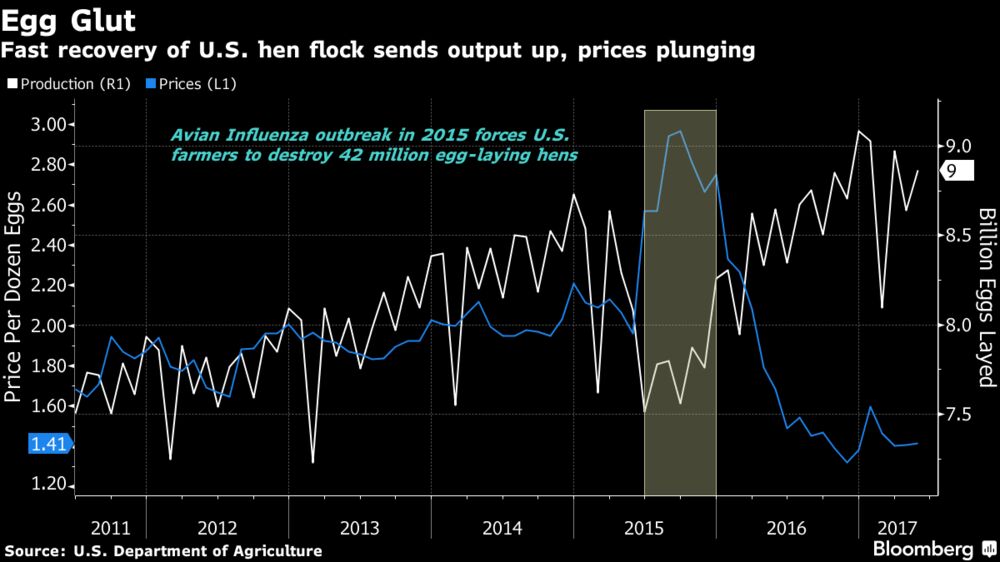
Supply & Demand And The Price Of Eggs

Bring on the Omelets: Bigger Flocks Send Egg Price to Decade-Low by Sydney Maki of Bloomberg. Excerpts:
"Supplies in the U.S. have surged so much in recent months that prices are the lowest for this time of year in at least a decade. It will probably take awhile for consumers to eat through the surplus inventory, so the government is predicting egg costs will drop more than any other food group in 2017.

The slump marks a sharp turnaround in the egg business. In 2015, an avian influenza outbreak forced farmers to destroy millions of birds and prices skyrocketed. Eager to take advantage of the rally, producers expanded flocks that were the biggest ever by the end of last year. But demand hasn’t keep pace. While some farms have scaled back in recent months, hens have gotten more productive, keeping the market flush with supply."

Demand for any food item is usually pretty steep or inelastic. If the price of eggs falls, you might eat a few more but you can only put so much in your stomach and then there is the cholesterol. So any change in supply will affect price quite a bit.

What might be happening now is that farmers over reacted to the high prices caused by decrease in supply from the avian influenza. The current increase in supply might have more than offset the previous decrease.

"The market was temporarily starved for eggs, and now it’s drowning," said Tom Elam, president of Carmel, Indiana-based consulting firm FarmEcon LLC. "There’s just too many eggs out there.”

Retailers were charging $1.414 on average for a dozen eggs in May, the lowest for the month since 2006, Bureau of Labor Statistics data show. Prices have plummeted 52 percent from a record $2.966 reached in September 2015. Costs are on track to fall by as much as 6 percent this year, the U.S. Department of Agriculture forecasts. The decline comes even with overall food inflation projected at as much as 2 percent.

Retailers were charging $1.414 on average for a dozen eggs in May, the lowest for the month since 2006, Bureau of Labor Statistics data show. Prices have plummeted 52 percent from a record $2.966 reached in September 2015. Costs are on track to fall by as much as 6 percent this year, the U.S. Department of Agriculture forecasts. The decline comes even with overall food inflation projected at as much as 2 percent."

""Historically, the egg industry has experienced many boom and bust cycles with periods of overproduction disrupting the supply-demand balance," Cal-Maine Chief Executive Officer Adolphus Baker said during a presentation earlier this month."

"for now, farmers aren’t reducing their flocks fast enough to have a major impact on prices, Elam said. At the same time, even with smaller animal numbers, egg production is rising because the hens are younger and genetically more productive, said Knox Jones, a dairy analyst at Advanced Economic Solutions."

As of June 1, 100 hens produced an average 77.1 eggs per day, the USDA said in a June 23 report. That’s up 1 percent from 76.3 a year earlier.

Adding a further drag on prices, the industry-wide move to increase cage-free production is limiting farmers’ ability to trim flocks. By 2050, as much as 75 percent of output will be cage-free, up from about 14 percent now, Jones estimates. The move comes as companies such as McDonald’s Corp. have pledged to move to cage-free eggs to meet growing demand from consumers focused on animal welfare."

Sunday, July 02, 2017

2017 is likely to be the best year in the history of humanity

Good News, Despite What You’ve Heard by Nicholas Kristof of the NY Times. Excerpts:
"we are defeating leprosy. Worldwide, cases have dropped 97 percent since 1985, and it is now easily treatable. A global plan set 2020 as a target for no more children to become deformed by leprosy.

The progress against leprosy reflects the larger gains against poverty and disease — which I believe may be the most important trend in the world today. Certainly it’s the best news nobody knows about."

"Just since 1990, more than 100 million children’s lives have been saved through vaccinations and improved nutrition and medical care. They’re no longer dying of malaria, diarrhea or unpleasant causes like having one’s intestines blocked by wriggling worms."

"There has been a stunning decline in extreme poverty, defined as less than about $2 per person per day, adjusted for inflation. For most of history, probably more than 90 percent of the world population lived in extreme poverty, plunging to fewer than 10 percent today.

Every day, another 250,000 people graduate from extreme poverty, according to World Bank figures. About 300,000 get electricity for the first time. Some 285,000 get their first access to clean drinking water. When I was a boy, a majority of adults had always been illiterate, but now more than 85 percent can read.

Family planning leads parents to have fewer babies and invest more in each. The number of global war deaths is far below what it was in the 1950s through the 1990s, let alone the murderous 1930s and ’40s."