
"The U.S. has a progressive income tax structure, with seven rates ranging from 10 percent to 39.6 percent. The more you earn in wages and salary, the greater the percentage you pay in taxes.
As a result, one-fifth of American households pay roughly two-thirds of federal income taxes. We’re already in “disproportionate” territory. Logic dictates, therefore, that those who pay more would experience a greater absolute “benefit” from an “across-the-board” cut in income taxes.
Moreover, the concept of “across-the-board” income tax cuts is itself erroneous when almost half of all Americans pay no net income tax. Either they have no taxable income, or it’s canceled out by all the deductions, exemptions, credits and other loopholes."
"“Tax cuts pay for themselves.”
Indulging the notion for argument’s sake, it’s hard to tell for sure whether tax cuts “pay for themselves.” The Congressional Budget Office doesn’t even try, preferring the use of static scoring to predict the effects; a tax cut of $1 necessarily means a loss of revenue for Uncle Sam of $1.
However, it’s safe to say that most of us do not take increased disposable income and simply stuff it under the mattress. By virtue of that fact alone, it contributes to increased economic activity.
Many of us go shopping. My uncle stuffed most all his career raises into savings, which banks typically turn around and lend to those who have an immediate use for it.
And then there are folks like a couple friends of mine.
In the last couple years, they have either expanded an existing business or opened other businesses. That requires buying new capital equipment, wiring a new building for electricity, water, etc., and hiring new staff, some of whom will pay income taxes."
"“Taxes are the price we pay to live in a civilized society.”
Supreme Court Justice Oliver Wendell Holmes Jr. coined that phrase in a 1927 court case about business insurance premiums. Before it was bandied about as a rationalization for the size of our government, “civilized society” had a simpler meaning: to protect the private property that fosters widespread prosperity; to provide police forces and a court system to settle disputes; and to carry out other government services.
Is it really “civilized” for someone to commandeer the earnings of her neighbor to pay for her pet project? The person coerced is really paying for the requisitioner’s haughtiness and lack of initiative."
Tuesday, June 20, 2017
Tax lingo for dummies
Article by Chris Baecker. It was printed in The San Antonio Express-News about a month ago. He manages fixed assets for Pioneer Energy Services and is an adjunct lecturer at Northwest Vista College (San Antonio College, where I teach is part of the same school system). Very interesting article with alot of food for thought. Excerpts:

Saturday, June 17, 2017
What’s the price? Internet companies are playing with charging different prices for the same thing depending on who you are. Is that a problem?
By Koen Smets. It deals with price discrimination. Charging different prices to different groups of customers based on their ability and willingness to pay (a
discount) is price discrimination.
I did a recent post called Amazon offers a discount on Prime for lower-income shoppers-but is it just a form of price discrimination?
I did a recent post called Amazon offers a discount on Prime for lower-income shoppers-but is it just a form of price discrimination?
Friday, June 16, 2017
OPEC Stumbles in Face of Oil Glut (example of how hard it is for cartels to achieve their objectives)
Production cuts aren’t drawing oil out of storage and are helping U.S. shale producers
By Summer Said, Georgi Kantchev and Neanda Salvaterra of the WSJ.
Cartels seek to raise price by having all of its members cut output. By acting as one company, a monopoly, they actually increase profits for all members. But there are incentives for members to cheat and try to sell more oil than their quota. This drives down the price. But producers who are not part of the cartel, like U.S. companies have more of an incentive to produce oil, which then drives the price back down.
The book The Economics of Public Issues by Roger LeRoy Miller, Daniel K. Benjamin and Douglass C. North has a chapter on cartels that discuss OPEC and why it cannot always meet its objectives. They point out the conditions necessary for cartels to work:

By Summer Said, Georgi Kantchev and Neanda Salvaterra of the WSJ.
Cartels seek to raise price by having all of its members cut output. By acting as one company, a monopoly, they actually increase profits for all members. But there are incentives for members to cheat and try to sell more oil than their quota. This drives down the price. But producers who are not part of the cartel, like U.S. companies have more of an incentive to produce oil, which then drives the price back down.
"OPEC is running smack into a wall of crude-oil storage.About OPEC's cuts
The global oil glut is proving immune to the limits set by the Organization of the Petroleum Exporting Countries and its big-producer allies like Russia, fueling the idea that output caps withholding almost 2% of world crude supply were a miscalculation.
Both Brent, the international benchmark, and West Texas Intermediate, the U.S. price setter, fell almost 4% to their lowest levels of 2017 on Wednesday after the release of fresh data about inventories. Overall, prices are down over 17% since the beginning of the year.
In the U.S., the Energy Information Administration said Wednesday that crude stockpiles fell last week by 1.7 million barrels, less than the 2.6 million drop forecast by a Wall Street Journal survey. At the same time, gasoline inventories rose by 2.1 million barrels, compared with the survey’s expectation of a 700,000 decline, underlining worries about the oversupply extending to crude oil’s products.
Oil stockpiles in the Organization for Economic Cooperation and Development—a club of 35 countries with industrialized economies—rose by 18.6 million barrels in April and were higher than they were when OPEC agreed to its cut late last year, said the International Energy Agency, a Paris-based group that advises governments on energy trends.
“There’s still so much crude in storage," said Doug King, chief investment officer at RCMA Asset Management and manager of that firm’s $200 million Merchant Commodity hedge fund. “OPEC needs much deeper cuts to draw inventory.”
Adding to oil traders’ angst: U.S. oil production has come roaring back to life. The IEA said U.S. crude supply will grow almost 5% on average this year, and nearly 8% in 2018, potentially vaulting American producers ahead of Saudi Arabia in daily output."
"Bjarne Schieldrop, chief commodities analyst at SEB Markets, the Nordic bank, said “It would stimulate production in the U.S. too much and this is basically what we are seeing."Click here to see historical gas prices. They fluctuate quite a bit, showing that OPEC cannot always maintain its hold on the market. (that only goes up through 2015. Gas prices went down almost 13% in 2016 compared to 2015, adjusted for inflation and so far this year they are up about 8% over last year).
"Eugen Weinberg, an oil analyst at Commerzbank, said OPEC needed to end its production cut. “The only option that OPEC has for the next five years is to let the market go”"
"OPEC representatives ... pointed to a problem of rising production from Libya and Nigeria, which were exempted from obligations."
"Daniel Yergin, vice chairman of IHS Markit and a long-time oil market watcher, said OPEC wouldn’t abandon its production-cut agreement, which took almost a year to put together through 2016.
“When OPEC and the other producers agreed to this deal, they hoped that, as the old adage says, time heals all—and time will heal the inventory problem,” Mr. Yergin said. “They should now take a deep breath and realize this will take a lot more time.”"
"OPEC ... blamed U.S. shale for slowing its rebalancing efforts."
"In 2018, non-OPEC production is set to increase by 1.5 million barrels a day"
The book The Economics of Public Issues by Roger LeRoy Miller, Daniel K. Benjamin and Douglass C. North has a chapter on cartels that discuss OPEC and why it cannot always meet its objectives. They point out the conditions necessary for cartels to work:

Thursday, June 15, 2017
CPS Energy uses behavioral science to reduce energy usage during peak times
See CPS draws on psychology to motivate customers to cut energy use in new program by Samantha Ehlinger of The San Antonio Express-News. But one thing the article does not discuss is how much higher prices would affect consumption during peak times and compare that to how well this program works. Excerpt:
"CPS Energy is using behavioral science techniques, and some high-tech data analysis, in a new program that taps on deeply rooted psychological drives to reduce energy usage during peak times.
The pilot program will be rolled out to up to 100,000 customers this summer and uses data culled from the company’s new smart meters to influence consumer behavior. The strategy itself is relatively simple: showing customers their energy consumption compared with their neighbors and letting their competitive instincts do the rest.
“Plucking on their competitive spirit, you can get them to reduce their energy use, anywhere between 1 and 3 percent over the course of a year,” said Neel Gulhar, a senior director of product strategy at Oracle Utilities. CPS has contracted with the company to run the program.
Oracle Utilities draws on behavioral science techniques to motivate the change. The most-used technique, according to Gulhar, is called “normative comparison.”
“This is where you compare the energy use of a household to households that are like them,” he said, later adding, “Time and time again, we find that if you use these different behavioral science techniques, you can actually change behavior.”
Competition is a deeply rooted instinct in human nature, a biological trait that evolved along with the basic need for survival, social psychologist Sander van der Linden at Cambridge University wrote in Psychology Today.
The program taps on that drive to win by sending out reports through email that analyze a customer’s behavior and compare it with others in the program. It’s “a little bit of a gamification thing,” said CPS Chief Operating Officer Cris Eugster. The program wouldn’t have been possible without more granular data from the utility’s new smart meters, which transmit data remotely and eliminate the need for a meter reader to record it each month, said Rick Luna, senior manager of product development at CPS.
The goal is to persuade customers to reduce their use during high-demand days, and the utility projects that it can save about 11 megawatts of energy usage, Luna said. One megawatt can power roughly 200 Texas homes during peak usage, according to the Electric Reliability Council of Texas."
Wednesday, June 14, 2017
Want to be happy and successful? Try compassion
By Jen Christensen of CNN.
Economists assume that people are selfish. It seems reasonable to also assume that selfish people want to be happy and successful. So it could be in the interest of selfish people to be compassionate. This might be a variation on the invisible hand of Adam Smith, the idea that it leads self-interested people to act for the good of society.
Excerpt:
Below is a related post I did in January called "The Dalai Lama Says It Is Sometimes OK To Be Selfish."
"This is mostly a post from November, 2013. But there was another article about something similar involving the Dalai Lama this week. So I have a bit about that at the end of this post.
And of course, Adam Smith said when people act selfishly they are led, as if by an invisible hand, to make society better off.
So when might it be OK to be selfish according to his holiness? When caring for others.
Wait, how can that be selfish? Or is this some kind of Zen riddle like what is the sound of one hand clapping? No, it's biology and evolution. See Lending a hand does a body good by Jessica Belasco, from the San Antonio Express-News, 10-25-2013.
She talked to Dr. James R. Doty, a neurosurgeon at the Stanford University School of Medicine and founder of Stanford's Center for Compassion and Altruism Research and Education. Excerpts:
There is an interesting book called Paleopoetics: The Evolution of the Preliterate Imagination. It relates storytelling to evolution.
Click here to go the Amazon listing. It is by Christopher Collins, professor emeritus of English at New York University. Here is the description:
Here is the new article from this week The Dalai Lama Explains Why Being Kind to Others is the Secret to Happiness. Excerpt:
Economists assume that people are selfish. It seems reasonable to also assume that selfish people want to be happy and successful. So it could be in the interest of selfish people to be compassionate. This might be a variation on the invisible hand of Adam Smith, the idea that it leads self-interested people to act for the good of society.
Excerpt:
"The compassionate tend to have deeper connections with others and more friends. They are more forgiving and have a stronger sense of life purpose. Many studies have shown these results. Compassion also has direct personal benefit. The compassionate tend to be happier, healthier, more self-confident, less self-critical, and more resilient."The article also discusses compassion exercises that change your brain.
Below is a related post I did in January called "The Dalai Lama Says It Is Sometimes OK To Be Selfish."
"This is mostly a post from November, 2013. But there was another article about something similar involving the Dalai Lama this week. So I have a bit about that at the end of this post.
And of course, Adam Smith said when people act selfishly they are led, as if by an invisible hand, to make society better off.
So when might it be OK to be selfish according to his holiness? When caring for others.
Wait, how can that be selfish? Or is this some kind of Zen riddle like what is the sound of one hand clapping? No, it's biology and evolution. See Lending a hand does a body good by Jessica Belasco, from the San Antonio Express-News, 10-25-2013.
She talked to Dr. James R. Doty, a neurosurgeon at the Stanford University School of Medicine and founder of Stanford's Center for Compassion and Altruism Research and Education. Excerpts:
"Practicing compassion — recognizing someone else is suffering and wanting to help relieve that suffering — just might be as important for health as exercise or a healthful diet, some scientists believe.Adam Smith wrote a book called The Theory of Moral Sentiments. One point he made there was that we are able to sympathize with other people by trying imagine what they are going through (and I wonder if we need to be good storytellers to be able to do that). Neuroeconomist Paul Zak has been studying how the hormone oxytocin plays a role in making us feel good when we have empathy for others (beware: Zak is a big hugger). See an earlier post Adam Smith vs. Bart Simpson for more details.
When we respond to another person's needs, our body responds in turn:
We become relaxed and calm.
Our blood pressure goes down.
Our stress level goes down.
Practicing compassion is associated with lengthened telomeres, the DNA that protects the ends of your chromosomes and is a marker of longevity.
To understand why humans are hard-wired for compassion, Doty said, just look at human evolution: Caring for others was essential to the survival of the species. Humans developed powerful neuropathways associated with nurturing and bonding with their offspring as motivation to care for them in a hostile environment; otherwise their genes could not be passed on. The same was true beyond the nuclear family when humans formed hunter/gatherer tribes.
A few hundred millennia later, our need for compassion remains strong. We may not be facing predators as our ancestors did, but frequent low-level stressors — work deadlines, traffic noise, our cellphone buzzing with texts — keep our fight-or-flight response continually engaged. That releases stress hormones, which raises the risk of disease.
When we're responding to others' needs, though, we engage the “parasympathetic nervous system,” relaxing us, Doty said. Stress hormones decrease, and the immune system is boosted. In fact, that occurs even if we just think about performing a good act for someone.
That's why intervening when someone needs help — whether in the form of a hug, reassurance, financial help or something else — has a powerful impact not just on the person being helped but on the helper.
Studies also have shown that volunteering, which is a way to practice compassion, helps increase longevity — but with an important exception. Study subjects who said they were volunteering to impress somebody or for some other benefit, not because they authentically wanted to help others, didn't enjoy the same benefit."
There is an interesting book called Paleopoetics: The Evolution of the Preliterate Imagination. It relates storytelling to evolution.
Click here to go the Amazon listing. It is by Christopher Collins, professor emeritus of English at New York University. Here is the description:
"Christopher Collins introduces an exciting new field of research traversing evolutionary biology, anthropology, archaeology, cognitive psychology, linguistics, neuroscience, and literary study. Paleopoetics maps the selective processes that originally shaped the human genus millions of years ago and prepared the human brain to play, imagine, empathize, and engage in fictive thought as mediated by language. A manifestation of the "cognitive turn" in the humanities, Paleopoetics calls for a broader, more integrated interpretation of the reading experience, one that restores our connection to the ancient methods of thought production still resonating within us.Click here to read a longer description by Collins himself.
Speaking with authority on the scientific aspects of cognitive poetics, Collins proposes reading literature using cognitive skills that predate language and writing. These include the brain's capacity to perceive the visible world, store its images, and retrieve them later to form simulated mental events. Long before humans could share stories through speech, they perceived, remembered, and imagined their own inner narratives. Drawing on a wide range of evidence, Collins builds an evolutionary bridge between humans' development of sensorimotor skills and their achievement of linguistic cognition, bringing current scientific perspective to such issues as the structure of narrative, the distinction between metaphor and metonymy, the relation of rhetoric to poetics, the relevance of performance theory to reading, the difference between orality and writing, and the nature of play and imagination."
Here is the new article from this week The Dalai Lama Explains Why Being Kind to Others is the Secret to Happiness. Excerpt:
"Have you ever wondered why it matters that you care for other people?Then the article has a long statement from the Dalai Lama on this philosophy. But some economists might say that you can't run a successful business if you don't care about others and try to learn their wants and desires. Here is what Adam Smith said in The Wealth of Nations
It seems commonsense that this is a good way to live life. But there are dominant philosophies today that suggest we need to maximize our own individual self-interest.
This comes from economic theories of capitalism that suggest when people look after their own self-interest, then society is better off.
The Dalai Lama explains why this doesn’t make sense in the beautiful passage below. As he says, it’s an obvious fact that your own sense of wellbeing can be provided through your relationships with others. So it’s best to start cultivating practices of kindness and compassion."
“It is not from the benevolence of the butcher, the brewer, or the baker that we expect our dinner, but from their regard to their own self-interest. We address ourselves not to their humanity but to their self-love, and never talk to them of our own necessities, but of their advantages”"
Tuesday, June 13, 2017
The Amount of Your Compensation Going Toward Benefits Keeps Rising
By Josh Zumbrun of the WSJ.
In my micro class, when I cover poverty, incomes and the income distribution, this is something that I mention when talking about incomes over time. Maybe they have not gone up as much as they used to because more of employee compensation has been going to benefits. The trend that Zumbrun discusses has been there before even 2006.
Excerpts:
In my micro class, when I cover poverty, incomes and the income distribution, this is something that I mention when talking about incomes over time. Maybe they have not gone up as much as they used to because more of employee compensation has been going to benefits. The trend that Zumbrun discusses has been there before even 2006.
Excerpts:
"In 2006, just over 70% of employer costs went to wages and salaries. That’s now down to 68.3%, the lowest point in the data."
"In the first quarter of 2017, employers spent $24.10 an hour in wages and $11.18 in benefits for every hour of work.
The breakdown on those benefits: $2.91 for health insurance, $2.49 on various types of paid leave (including vacation time, sick pay, holiday pay and personal leave), $1.95 for Social Security and Medicare, and $1.88 on other benefits (including unemployment and disability, life insurance, workers’ compensation payments, and various types of supplemental pay.)
Taking inflation into account, the gap in growth rates between wages and benefits becomes starker. Real wages have grown just 4% in total since 2006, according to this report’s measure. Real benefits have grown 12.4% over that period."
Monday, June 12, 2017
Smart rule-breakers make the best entrepreneurs
By Adam Millsap of the Mercatus Center at George Mason University. Excerpts:
"A new paper in the Quarterly Journal of Economics (working version here) finds that the combination of intelligence and a willingness to break the rules as a youth is associated with a greater tendency to operate a high-earning incorporated business as an adult i.e. be an entrepreneur.
Previous work examining entrepreneurship that categorizes all self-employed persons as entrepreneurs has often found that entrepreneurs earn less than similar salaried workers. But this contradicts the important role entrepreneurs are presumed to play in generating economic growth. As the authors of the new QJE paper remark:
“If the self-employed are a good proxy for risk-taking, growth-creating entrepreneurs, it is puzzling that their human capital traits are similar to those of salaried workers and that they earn less.”So instead of looking at the self-employed as one group, the authors separate them into two groups: those who operate unincorporated businesses and those who operate incorporated businesses. They argue that incorporation is important for risk-taking entrepreneurs due to the limited liability and separate legal identity it provides, and they find that those who choose incorporation are more likely to engage in tasks that require creativity, analytical flexibility and complex interpersonal communications; all tasks that are closely identified with the concept of entrepreneurship.
People who operate unincorporated businesses, on the other hand, are more likely to engage in activities that require high levels of hand, eye and foot coordination, such as landscaping or truck driving."
"On average incorporated business owners earn more, work more hours, have more years of schooling and are more likely to be a college graduate than both unincorporated business owners and salaried workers based on two different data sets."
"people with high self-esteem, a strong sense of controlling one’s future, high Armed Forces Qualifications Test scores (AFQT)—which is a measure of intelligence and trainability—and a greater propensity for engaging in illicit activity as a youth are more likely to be incorporated self-employed.
Moreover, it’s the combination of intelligence and risk-taking that turns a young person into a high-earning owner of an incorporated business. As the authors state, “The mixture of high learning aptitude and disruptive, “break-the-rules” behavior is tightly linked with entrepreneurship.”
These findings fit nicely with some notable recent examples of entrepreneurship—Uber and Airbnb. Both companies are regularly sued for violating state and local ordinances, but this hasn’t stopped them from becoming popular providers of transportation and short-term housing.
If the founders of Uber and Airbnb always obtained approval before operating the companies would be hindered by all sorts of special interests, including taxi commissions, hotel industry groups and nosy neighbors. Seeking everyone’s approval—including the government’s—before operating likely would have meant never getting off the ground and the companies know this. It’s interesting to see evidence that many other, less well-known entrepreneurs share a similar willingness to violate the rules if necessary in order to provide their goods and services to customers."
Friday, June 09, 2017
Are Robots Going to Steal Our Jobs? Many technologists think so, but economists aren't so easily convinced
By Ronald Bailey of Reason Magazine.
This is a fairly long article, but we certainly hear alot about this. Bailey shows that jobs have changed quite a bit since the industrial revolution. Many were destroyed (that is, workers were replaced by machines), but many new jobs were created.
And before excerpts from the Bailey article, here is a link to an article Paul Krugman wrote in Slate. He explains how, if the technology for making hot dogs improves, the laid off workers will get jobs making hot dog buns, since, if more hot dogs are being made, more buns will have to be made.
Now, excerpts from the Bailey article:
This is a fairly long article, but we certainly hear alot about this. Bailey shows that jobs have changed quite a bit since the industrial revolution. Many were destroyed (that is, workers were replaced by machines), but many new jobs were created.
And before excerpts from the Bailey article, here is a link to an article Paul Krugman wrote in Slate. He explains how, if the technology for making hot dogs improves, the laid off workers will get jobs making hot dog buns, since, if more hot dogs are being made, more buns will have to be made.
Now, excerpts from the Bailey article:
"The conventional wisdom among technologists is well-established: Robots are going to eat our jobs. But economists tend to have a different perspective.
Over the past two centuries, they point out, automation has brought us lots more jobs—and higher living standards too. "Is this time different?" the Massachusetts Institute of Technology economist David Autor said in a lecture last year. "Of course this time is different; every time is different. On numerous occasions in the last 200 years scholars and activists have raised the alarm that we are running out of work and making ourselves obsolete.…These predictions strike me as arrogant."
"We are neither headed toward a rise of the machine world nor a utopia where no one works anymore," said Michael Jones, an economist at the University of Cincinnati, last year. "Humans will still be necessary in the economy of the future, even if we can't predict what we will be doing." When the Boston University economist James Bessen analyzed computerization and employment trends in the U.S. since 1980, his study concluded that "computer use is associated with a small increase in employment on average, not major job losses."
"The economist John Maynard Keynes warned in 1930 that the "means of economising the use of labour [is] outrunning the pace at which we can find new uses for labour," resulting in the "new disease" of "technological unemployment." In 1961, Time warned: "Today's new industries have comparatively few jobs for the unskilled or semiskilled, just the class of workers whose jobs are being eliminated by automation." A 1989 study by the International Metalworkers Federation forecasted that within 30 years, as little as 2 percent of the world's current labor force "will be needed to produce all the goods necessary for total demand." That prediction has just two years left to come true."
"In a 2011 television interview, President Barack Obama worried that "a lot of businesses have learned to become much more efficient with a lot fewer workers." To illustrate his point, Obama noted, "You see it when you go to a bank and you use an ATM, you don't go to a bank teller." But the number of bank tellers working in the U.S. has not gone down. Since 1990, their ranks have increased from around 400,000 to 500,000, even as the number of ATMs rose from 100,000 to 425,000. In his 2016 study, Bessen explains that the ATMs "allowed banks to operate branch offices at lower cost; this prompted them to open many more branches, offsetting the erstwhile loss in teller jobs." Similarly, the deployment of computerized document search and analysis technologies hasn't prevented the number of paralegals from rising from around 85,000 in 1990 to 280,000 today. Bar code scanning is now ubiquitous in retail stores and groceries, yet the number of cashiers has increased to 3.2 million today, up from just over 2 million in 1990, outpacing U.S. population growth over the same period.
This illustrates why most economists are not particularly worried about the notion of widespread technological unemployment. When businesses automate to boost productivity, they can cut their prices, thus increasing the demand for their products, which in turn requires more workers. Furthermore, the lower prices allow consumers to take the money they save and spend it on other goods or services, and this increased demand creates more jobs in those other industries. New products and services create new markets and new demands, and the result is more new jobs."
"Since the advent of the smartphone just 10 years ago, for example, an "app economy" has emerged that "now supports an astounding 1.66 million jobs in the United States," Progressive Policy Institute economist Michael Mandel reports. According to the Entertainment Software Association, more than 220,000 jobs now depend on the game software industry. The IBISWorld consultancy estimates that 227,000 people work in web design, while the Biotechnology Innovation Organization says that U.S. bioscience companies employ 1.66 million people. Robert Cohen, a senior fellow at the Economic Strategy Institute, projects that business spending on cloud services will generate nearly $3 trillion more in gross domestic product and 8 million new jobs from 2015 to 2025."
""Electrification transformed businesses, the overall economy, social institutions, and individual lives to an astonishing degree—and it did so in ways that were overwhelmingly positive," Martin Ford writes in his book Rise of the Robots. But why doesn't Martin mourn all the jobs that electrification destroyed? What about the ice men? The launderers? The household help replaced by vacuum cleaners and dishwashers? The firewood providers? The candle makers?
To ask is to answer. Electricity may have killed a lot of jobs, but on balance it meant many more."
Thursday, June 08, 2017
Structural Unemployment In The News
See U.S. Job Openings Hit New High: April survey shows openings rate matched its highest level on record at 4% by Jeffrey Sparshott of the WSJ.
In my macroeconomics class, we talk about the types of unemployment. Here is one of them:
Structural-unemployment caused by a mismatch between the skills of job seekers and the requirements of available jobs.
Also, don't forget, the unemployment rate may not always be the best indicator of the labor market.
The percentage of 25-54 year olds employed is 78.4% for May. It was 78.6% in April. It is still below the 79.7% in December 2007 when the recession started. Click here to see the BLS data. The unemployment rate was 4.3% in May. Click here to go to that data.
Here are excerpts from the article:
In my macroeconomics class, we talk about the types of unemployment. Here is one of them:
Structural-unemployment caused by a mismatch between the skills of job seekers and the requirements of available jobs.
Also, don't forget, the unemployment rate may not always be the best indicator of the labor market.
The percentage of 25-54 year olds employed is 78.4% for May. It was 78.6% in April. It is still below the 79.7% in December 2007 when the recession started. Click here to see the BLS data. The unemployment rate was 4.3% in May. Click here to go to that data.
Here are excerpts from the article:
"The number of U.S. job openings hit a new high in April while hiring slowed, a sign that employers are struggling to find workers.
The number of job openings rose by 259,000 to 6.04 million, the Labor Department said Tuesday, the highest level recorded since the government started tracking the figure at the end of 2000. The number of hires, meanwhile, fell by 253,000 to 5.05 million in April.
“The sharp rise in openings while hirings fell provides some indication that labor markets have tightened so much as to suggest we may be facing a shortage of qualified workers,” said Raymond Stone, an economist at Stone & McCarthy Research Associates, in a note to clients."
"The U.S. economy has been advancing at a historically slow but broadly steady pace through the current expansion, spurring a long stretch of hiring. Now, some economists are surmising that the ranks of Americans who are unemployed or out of the workforce may not have the skill set employers are demanding of their employees."
"“I think the skills mismatch between what workers have and what employers are demanding might be weighing on the labor market,” said Michael Pugliese, an economic analyst at Wells Fargo."
Wednesday, June 07, 2017
Amazon offers a discount on Prime for lower-income shoppers-but is it just a form of price discrimination?
See Amazon is going after Walmart with a 45 percent discount on Prime for lower-income shoppers by Jason Del Rey of recode. Excerpt:
"Amazon already owns the high-income shopper segment in the U.S. Now it’s making a bid to court those who have less income at their disposal.On Tuesday, Amazon announced that it is offering a 45 percent discount on Prime memberships — $5.99 a month instead of $10.99 month — to U.S. residents receiving government assistance.Shoppers with an Electronic Benefits Transfer card — used for benefits like the Women, Infants, and Children Nutrition Program — are eligible for the lower price but they also have to re-qualify every year for up to four years.The move comes a little over a year after Amazon first introduced the $10.99 monthly payment option for Prime, which was previously only available for an annual fee of $99.The monthly option comes with the same perks like free two-day shipping on tens of millions of items and access to a large selection of online movies and TV shows for no extra charge."
Charging different prices to different groups of customers based on their ability and willingness to pay (a
discount) is price discrimination.
Why price discrimination raises profits
1. If a firm can get a higher price from some customers than others they increase their profits.
2. If a firm can lower the price for others who might not have bought the product to begin with, they also increase their profits.
Necessary Conditions for Price Discrimination
1. The firm must face a downward sloping demand. Monopolies do but firms in perfect competition do not (their demand, also their MR line, is flat).
2. The firm must be able to readily (and cheaply) identify buyers or groups of buyers with predictably different elasticities of demand (senior citizens have a more elastic demand and will shop around more since they have more time so restaurants might give them a discount). The more elastic the demand, the greater the change in quantity demanded for a given change in price.
3. The firm must be able to prevent resale of the product or service. If a student can buy a movie ticket for $6 while everyone else pays $8, the firm will lose money if the students turn around and sell their tickets for $7. So the theater can prevent resale by checking student IDs to make sure people holding the lower price ticket really are students.
Why price discrimination raises profits
1. If a firm can get a higher price from some customers than others they increase their profits.
2. If a firm can lower the price for others who might not have bought the product to begin with, they also increase their profits.
Necessary Conditions for Price Discrimination
1. The firm must face a downward sloping demand. Monopolies do but firms in perfect competition do not (their demand, also their MR line, is flat).
2. The firm must be able to readily (and cheaply) identify buyers or groups of buyers with predictably different elasticities of demand (senior citizens have a more elastic demand and will shop around more since they have more time so restaurants might give them a discount). The more elastic the demand, the greater the change in quantity demanded for a given change in price.
3. The firm must be able to prevent resale of the product or service. If a student can buy a movie ticket for $6 while everyone else pays $8, the firm will lose money if the students turn around and sell their tickets for $7. So the theater can prevent resale by checking student IDs to make sure people holding the lower price ticket really are students.
#2 might be the key here for Amazon. The lower income customers will be spending a bigger share of their budgets on Amazon products and services. One of the determinants of elasticity is how much of your budget you spend on the item. As this goes up, your demand becomes more elastic (that is, quantity will change more for a given change in price). You are affected alot more by a change in the price of cars than a change in the price of donuts. So if the price of cars doubles, the quantity demanded will fall much more than if the price of donuts doubles.
And when firms can price discriminate, as explained above, they will charge lower prices (offer discounts) to those groups with higher elasticities. The number of substitute goods and the amount of time consumes have to adjust to price changes also affect elasticity.
Tuesday, June 06, 2017
The Diminishing Returns of a College Degree
In the mid-1970s, far less than 1% of taxi drivers were graduates. By 2010 more than 15% were
By Richard Vedder and Justin Strehle in the WSJ. Mr. Vedder is director of the Center for College Affordability and Productivity and teaches at Ohio University, where Mr. Strehle studies economics. Excerpts:
By Richard Vedder and Justin Strehle in the WSJ. Mr. Vedder is director of the Center for College Affordability and Productivity and teaches at Ohio University, where Mr. Strehle studies economics. Excerpts:
"The cost of college attendance is rising while the financial benefits of a degree are falling."
"From 2000 to 2016, the tuition-and-fees component of the Consumer Price Index rose 3.54% annually (74.5% over the entire period), adjusting for overall inflation. With sluggish business investment, a slowdown in income growth has aggravated the rising burden of paying for higher education. American families have taken on more than $1.3 trillion in student-loan debt—more than what they borrow with credit cards or to buy cars."
"the earnings advantage associated with a bachelor’s degree compared with a high school diploma is no longer growing like it once did. Census data show that the average annual earnings differential between high school and four-year college graduates rose sharply, to $32,900 in 2000 (expressed in 2015 dollars) from $19,776 in 1975—only to fall to $29,867 by 2015."
"about 40% of recent college graduates are “underemployed,” often for a long time."
"recent attendees of Stanford University earn on average far more than twice as much as those attending Northern Kentucky University ($86,000 vs. $36,000). Electrical engineers typically earn twice as much as psychology majors."
"In recent years, male college graduates’ earning power has decreased significantly, as it has for whites and Asians. Not so for women, Hispanics and blacks, for whom the financial payoff to a college education has continued to rise. College graduates traditionally earn more than high school graduates in part because their degrees act as signaling devices in the job market."
"As the proportion of adult Americans with college degrees grows beyond one-third, being a college graduate no longer necessarily denotes exceptional vocational promise. The bachelor’s degree is not the reliable signaling device it once was."
Monday, June 05, 2017
Trade on the Streets, and Off the Books, Keeps Zimbabwe Afloat
By NORIMITSU ONISHI and JEFFREY MOYO of the NY Times. Excerpts:
"From 2011 to 2014, the percentage of Zimbabweans scrambling to make a living in the informal economy shot up to an astonishing 95 percent of the work force from 84 percent, according to the government. And of that small number of salaried workers, about half are employed by the government, including patronage beneficiaries with few real duties."
"An acute cash shortage persists despite the introduction of a surrogate currency in November. The government, unable to pay its workers their Christmas bonuses, has offered them land instead."
"As long lines keep forming outside banks, the continuing decline of the formal economy has raised fears of a repeat of the 2008 hyperinflation crisis, which was fueled by the unrestrained printing of the old Zimbabwean dollar, including a $100 trillion note."
"The government has occasionally cracked down — sometimes violently — on the street vendors, who are not licensed, describing their activities, near the seat of government and businesses, as an eyesore."
"According to an unspoken rule, the street vendors are allowed to operate only after dark on weekdays and starting in late afternoon on weekends."
"Zimbabwe’s per capita gross national income peaked with independence in 1980, when Mr. Mugabe seized power, and bottomed out with the hyperinflation crisis of 2008."
"Mr. Mugabe’s violent seizure of white-owned farms starting in 2000 precipitated a decline in manufacturing and a process of deindustrialization. Manufacturing peaked in 1992, accounting for about 30 percent of the gross domestic product. Now it is 11 percent and declining."
"With manufacturing’s sharp decline, as well as the resulting drop in exports and spike in imports, Zimbabwe suffers from a steep trade imbalance. That imbalance’s effect on the economy is exacerbated by the American dollar, which Zimbabwe adopted in 2009 to combat hyperinflation."
"Zimbabwe has experienced a crippling shortage of dollars since last March. Efforts to encourage the use of plastic money — and the introduction, so far, of nearly $100 million into the market of a surrogate currency called bond notes — have helped, though not enough. Customers still stand for hours in long lines outside banks to try to withdraw the few dollars available.
With the government now strictly controlling the transfer of dollars outside Zimbabwe, companies dependent on trade are finding it increasingly difficult to import critical goods."
"At a small auto parts shop in central Harare, called Track Board, Prince Mapira, 23, said American dollars had vanished from the marketplace. Customers now pay only in bond notes, which are recognized only inside Zimbabwe, creating a problem for his business."
"The auto shop needs American dollars to import parts from South Africa or Japan. So Mr. Mapira takes the bond notes, which are supposed to be the equivalent of the American dollar, to exchange on the black market.“If you go there with 100 dollars in bond notes, they give you $70 or $80,” he said. “It’s not equal on the black market.”"
Sunday, June 04, 2017
Getting paid to wake other people up was once a real job
See That was then, this is now at Marginal Revolution.
Friday, June 02, 2017
The percentage of 25-54 year-olds employed fell in May
One weakness of the unemployment rate is that if people drop out of the
labor force they cannot be counted as an unemployed person and the
unemployment rate goes down. They are no longer actively seeking work
and it might be because they are discouraged workers. The lower
unemployment rate can be misleading in this case. People dropping out of
the labor force might indicate a weak labor market.
We could look at the employment to population ratio instead, since that includes those not in the labor force. But that includes everyone over 16 and that means that senior citizens are in the group but many of them have retired. The more that retire, the lower this ratio would be and that might be misleading. It would not necessarily mean the labor market is weak.
But we have this ratio for people age 25-54 (which also eliminates college age people who might not be looking for work)
The percentage of 25-54 year olds employed is 78.4% for May. It was 78.6% in April. It is still below the 79.7% in December 2007 when the recession started. Click here to see the BLS data. The unemployment rate was 4.3% in May. Click here to go to that data.
Here is a good graph from the St. Louis Fed. It shows that there are about 125 million people in the 25-54 year old group. So since we are 1.3 percentage points below the 79.7% of December 2007, that is still 1.6 million fewer jobs (Hat tip: Vance Ginn of the Texas Public Policy Foundation).
Here is the timeline graph of the percentage of 25-54 year olds employed since 2007.

Here it is going all the way back to 1948

We could look at the employment to population ratio instead, since that includes those not in the labor force. But that includes everyone over 16 and that means that senior citizens are in the group but many of them have retired. The more that retire, the lower this ratio would be and that might be misleading. It would not necessarily mean the labor market is weak.
But we have this ratio for people age 25-54 (which also eliminates college age people who might not be looking for work)
The percentage of 25-54 year olds employed is 78.4% for May. It was 78.6% in April. It is still below the 79.7% in December 2007 when the recession started. Click here to see the BLS data. The unemployment rate was 4.3% in May. Click here to go to that data.
Here is a good graph from the St. Louis Fed. It shows that there are about 125 million people in the 25-54 year old group. So since we are 1.3 percentage points below the 79.7% of December 2007, that is still 1.6 million fewer jobs (Hat tip: Vance Ginn of the Texas Public Policy Foundation).
Here is the timeline graph of the percentage of 25-54 year olds employed since 2007.
Here it is going all the way back to 1948
Thursday, June 01, 2017
Startups Remain Stuck: Job Creation From New Establishments Lags
Some economists think a decline in dynamism is contributing to low productivity growth
By Jeffrey Sparshott of the WSJ. The monthly employment report comes out tomorrow and although unemployment is low, the percentage of 25-54 year-olds employed is still below what it was in December 2007, when the last recession began. I will post something on this tomorrow after the report is out.
So this article discusses why that might be the case. It also mentions "allocative efficiency," something I cover in both micro and macro. When the quantity of a good makes the marginal benefit equal to the marginal cost, we have allocative efficiency. This article suggests not enough resources are being put into new businesses, that is, the quantity of startups is too low.
Here are excerpts from the article:
By Jeffrey Sparshott of the WSJ. The monthly employment report comes out tomorrow and although unemployment is low, the percentage of 25-54 year-olds employed is still below what it was in December 2007, when the last recession began. I will post something on this tomorrow after the report is out.
So this article discusses why that might be the case. It also mentions "allocative efficiency," something I cover in both micro and macro. When the quantity of a good makes the marginal benefit equal to the marginal cost, we have allocative efficiency. This article suggests not enough resources are being put into new businesses, that is, the quantity of startups is too low.
Here are excerpts from the article:
"During the latest expansion, new establishments have accounted for a little more than 11% of all new private-sector jobs created in the U.S. During the 1990s, the figure was 15%, according to Labor Department data released Wednesday.
That may seem a small shift, but those few percentage points add up to nearly 300,000 jobs a quarter.
The startup slowdown also suggests a loss of dynamism across the broader U.S. economy, with Americans either less willing or less able to launch a new venture, and a decline in the kind of churn that leads to greater opportunity for workers and rising productivity.
“The evidence suggests that the decline in dynamism is reason for concern and sheds light on debates about the causes of slowing productivity growth,” economists Ryan Decker, John Haltiwanger, Ron Jarmin and Javier Miranda wrote in a February 2017 discussion paper for the Federal Reserve.
The latest Labor Department report tracks job creation from existing and new establishments. It shows that establishment “births” accounted for about 866,000 new jobs in the third quarter of 2016. That works out to about 11.3% of all jobs created during the period."
"Separate data from the Commerce Department show the trend goes back even further. The share of private firms less than a year old has dropped from more than 12% during much of the 1980s to only about 8% since 2010.
Why would that hurt productivity? Mr. Decker and his colleagues focus on allocative efficiency, or “the continual movement of resources to their most productive uses.” A decline in startups suggests that capital and labor aren’t getting moved to enough fast-growing young companies.
“Our findings imply that…declining business dynamism since 2000 is likely a drag on American living standards,” the paper said. “Moreover, our findings suggest a reevaluation of the productivity slowdown debate, which has until now focused on technological versus measurement explanations.”
Not everyone buys that explanation. A San Francisco Fed paper by economist Huiyu Li finds that incumbent firms contribute significantly to growth.
“In sum, focusing on the detrimental effects from fewer new businesses on aggregate productivity growth may undervalue the strong innovation that existing firms contribute to the economy,” Ms. Li wrote.
Even so, a decline in startups raises other red flags for the economy, including the possible effects of regulations, an aging population, a growing divide between cities and rural areas, outsourcing or simply a loss of entrepreneurial spirit."Fits and Starts Share of job gains from new establishments
Wednesday, May 31, 2017
Why It Is Hard To Raise The Rate Of Economic Growth
See Why Trump can’t be Reagan: Economic plan of reviving a 1980s style boom in America is pie in the sky Ruchir Sharma.
"The potential growth rate of an economy is roughly determined by two factors: population and productivity. An economy can grow steadily only by adding more workers, or by increasing output per worker. During the Reagan years, both population and productivity were growing at around 1.7% a year, so the potential US growth rate was close to 3.5%. In short, Reagan did not push the nation’s economic engine to run faster than it could handle." [I would add that more capital or better technology can also increase the output per worker-CM]
"America’s population and productivity growth have fallen to around 0.75% each, generously measured, so potential economic growth is roughly 1.5%. Any policy package that aims to push an economy beyond its potential could easily backfire – in the form of higher deficits and inflation.
In the last 1,000 years, no economy has ever broken free of the limits imposed by population growth. Before 1870, global population growth did not exceed 0.5%, and global economic growth did not exceed 1% for any sustained period. Before World War II population growth increased to 1%, and economic growth accelerated to about 2%. After the war, the baby boom pushed population growth towards 2%, and economic growth rose to nearly 4% for the first and only time."
"global population growth has fallen to about 1%. The baby boom has gone bust. With the US population growth rate falling – last year to the slowest rate recorded since the 1930s – it is unlikely that any president could juice the economy to grow at 3.5% or more over the next decade."
"let’s assume Trump can more than double US productivity growth to the rate achieved in the Reagan era, 1.7%. Given the slowdown in population growth, that productivity miracle would raise the potential GDP growth rate to around 2.5%. If that doesn’t sound so different from 3.5%, consider that every percentage point of growth in the domestic economy is worth more than $100 billion"
"Not every country with rapid population growth enjoyed a steady economic boom, but few economies boomed without it. And for most countries, the era of population growth is now over."
"Comparing growth in the US unfavourably to China and India, as Trump has, makes little sense because poorer countries always tend to grow faster. If your starting income is lower, it’s easier to double it."
Tuesday, May 30, 2017
How Cell-Phone Plans With Unlimited Data Limited Inflation
Economist traces almost half of the U.S. core-inflation slowdown this year to wireless services
By Ben Leubsdorf of the WSJ. Excerpt:
By Ben Leubsdorf of the WSJ. Excerpt:
"A slowdown in inflation over the last couple of months seems to be coming from Americans’ smartphones.
Many private economists and Federal Reserve policy makers expected price growth would pick up this year, with unemployment low and the job market tightening. But core inflation—prices excluding the volatile categories of food and energy—rose just 1.9% in April from a year earlier, decelerating from 2.3% growth in January, as measured by the Labor Department’s consumer-price index. Core prices actually fell in March from the prior month, the first time that had happened in more than seven years.
Multiple forces are at work, including a glut of used cars pushing down vehicle prices and a deceleration in medical inflation. But Paul Ashworth, chief U.S. economist at Capital Economics, said in a research note this week that nearly half of the decline in core CPI inflation this year can be traced to a single item: wireless telephone services.
Cell-plan prices dropped 7% in March and fell an additional 1.7% in April, according to Labor Department data. From April last year, wireless service prices were down 12.9%, the largest decline in 16 years.
Mr. Ashworth attributed the drop to “the price war that has broken out among cell-phone service providers, with all the big providers now offering unlimited data plans at cheaper rates.”
Intense competition among cell-service providers like Verizon Communications Inc., Sprint Corp., T-Mobile US Inc. and AT&T Inc. has driven down prices for years and Verizon, the nation’s largest wireless carrier, in February followed its rivals in reintroducing unlimited-data plans.
As it happens, government statisticians in January had changed how they adjust available prices for cell-phone plans to account for features that improve quality. “In March, these procedures resulted in downward adjustments for many quotes based on changes in plans, largely in changes in data limits,” Bureau of Labor Statistics economist Steve Reed said in an email."
Wednesday, May 24, 2017
What Is The Full-Employment Unemployment Rate According To The Fed?
A recent article says 4.7%. See Fed Likely to Go Ahead With Rate Hikes Despite Trump Turmoil by Rich Miller of Bloomberg. Excerpts:
Here is some more information to help explain this issue.
We can see how this works in the following graph:

A GDP of $9 trillion is the "full-employment" GDP (QF). That gives us the lowest rate of unemployment compatible with "price stability" (price stability is an an annual inflation rate of 3% or less-although the article says 2% since that is what the Fed seems to be using these days). As GDP increases, more workers are hired, so unemployment falls. But if GDP is below QF, firms cannot raise prices. There is slack or "excess capacity" in the economy. That means that there will be very little pressure on prices. Resources are not very scarce and product prices don't have to be increased (or increased very much) to call them back into service.
But as GDP increases, resources become more scarce as more bidders want them. The more GDP increases, the faster prices increase. Also, less efficient resources get called into service and less efficiency means greater cost. The higher costs get passed along to the consumer in higher prices.
So, if there is a danger of AD going past QF the FED will raise interest rates to slow down private spending (both consumption and investment) to keep AD from moving too far to the right and prevent the higher rates of inflation.
"Officials in March projected that the economy would grow 2.1 percent both this year and next, above their 1.8 percent estimate of its long-run cruising speed. They also reckoned that a 4.7 percent jobless rate was equivalent to full employment. Unemployment in April was 4.4 percent."
"Michael Feroli, chief U.S. economist at JPMorgan Chase & Co., said the course of inflation over the coming months will be more important in shaping the Fed’s plans than the political tumult in Washington.
Consumer-price inflation has slowed more than forecast in the last couple of months, raising questions about whether the Fed remains on track to achieve its 2 percent inflation target.
Feroli said the fundamentals point to inflation resuming its upward trend, with import and unit labor costs rising and the dollar falling.
As a result, he expects the Fed “to look past” the recent weakness in prices and raise interest rates again next month."
Here is some more information to help explain this issue.
We can see how this works in the following graph:
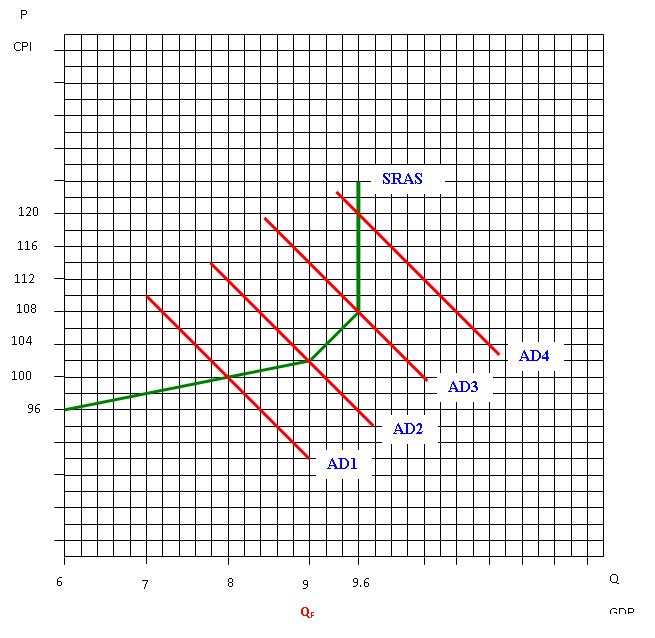
A GDP of $9 trillion is the "full-employment" GDP (QF). That gives us the lowest rate of unemployment compatible with "price stability" (price stability is an an annual inflation rate of 3% or less-although the article says 2% since that is what the Fed seems to be using these days). As GDP increases, more workers are hired, so unemployment falls. But if GDP is below QF, firms cannot raise prices. There is slack or "excess capacity" in the economy. That means that there will be very little pressure on prices. Resources are not very scarce and product prices don't have to be increased (or increased very much) to call them back into service.
But as GDP increases, resources become more scarce as more bidders want them. The more GDP increases, the faster prices increase. Also, less efficient resources get called into service and less efficiency means greater cost. The higher costs get passed along to the consumer in higher prices.
So, if there is a danger of AD going past QF the FED will raise interest rates to slow down private spending (both consumption and investment) to keep AD from moving too far to the right and prevent the higher rates of inflation.
Thursday, May 11, 2017
Interesting New Book On Trade And Tariffs By Marc-William Palen
See The 'Conspiracy' of Free Trade: The Anglo-American Struggle over Empire and Economic Globalisation, 1846-1896. Here is the Amazon description:
Here is the author's bio
Dr. Palen is from San Antonio. Here is a related post from a few months ago:
Mark Twain, Economist?
"Following the Second World War, the United States would become the leading 'neoliberal' proponent of international trade liberalization. Yet for nearly a century before, American foreign trade policy was dominated by extreme economic nationalism. What brought about this pronounced ideological, political, and economic about-face? How did it affect Anglo-American imperialism? What were the repercussions for the global capitalist order? In answering these questions, The 'Conspiracy' of Free Trade offers the first detailed account of the controversial Anglo-American struggle over empire and economic globalization in the mid- to late-nineteenth century. The book reinterprets Anglo-American imperialism through the global interplay between Victorian free-trade cosmopolitanism and economic nationalism, uncovering how imperial expansion and economic integration were mired in political and ideological conflict. Beginning in the 1840s, this conspiratorial struggle over political economy would rip apart the Republican Party, reshape the Democratic Party, and redirect Anglo-American imperial expansion for decades to come."
Here is the author's bio
"Dr. Marc-William Palen is a historian at the University of Exeter. He specialises in the intersection of British and American imperialism within the broader history of globalisation since c. 1800. His commentary on historical and contemporary global affairs has appeared in the New York Times, the Australian, History Today, Time Magazine, Newsweek, the Globalist Magazine, the History News Network, History & Policy, Foreign Policy in Focus, and Common Dreams, among others. He is co-founder of History & Policy's Global Economics and History Forum. He is also the founding editor of the Imperial & Global Forum, the blog of the Centre for Imperial & Global History at the University of Exeter. You can follow him on Twitter @MWPalen"
Dr. Palen is from San Antonio. Here is a related post from a few months ago:
Mark Twain, Economist?
Thursday, May 04, 2017
Adam Smith On Jeopardy
Here is the clue for Final Jeopardy on April 28:
Category: HISTORIC WORKS' FIRST LINES
Clue: "The annual labour of every nation is the fund which originally supplies it with all the necessaries and conveniences of life"
On Jeopardy, they give you the answer. So your response has to be in the form of a question.
The correct question: What is the Wealth of Nations?
Two of the three players got it right. One said Das Kapital (which was by Karl Marx)
Go to
Jeopardy, April 28, 2017. Scroll down to the bottom for Final Jeopardy.
Category: HISTORIC WORKS' FIRST LINES
Clue: "The annual labour of every nation is the fund which originally supplies it with all the necessaries and conveniences of life"
On Jeopardy, they give you the answer. So your response has to be in the form of a question.
The correct question: What is the Wealth of Nations?
Two of the three players got it right. One said Das Kapital (which was by Karl Marx)
Go to
Jeopardy, April 28, 2017. Scroll down to the bottom for Final Jeopardy.
Wednesday, April 19, 2017
Why Did The Value Of The Dollar Rise More Than 20% From July 2014 To March 2015?
On June 30, 2014 , the Trade Weighted U.S. Dollar Index: Major Currencies (DTWEXM) was 75.7 (the index starts in 1973 at 100, so the dollar was lower in value compared to other major currencies in 2014 than it was in 1973).
See Trade Weighted U.S. Dollar Index: Major Currencies (DTWEXM) from the St. Louis Federal Reserve Bank.
But by March 16, 2015, it was at 93.1, just about a 23% increase in value.
Why did the dollar rise? Here is what The Economist magazine said:
Here is another view from Andrew Hecht. He is an international commodity trader, an options expert and analyst.
See Trade Weighted U.S. Dollar Index: Major Currencies (DTWEXM) from the St. Louis Federal Reserve Bank.
But by March 16, 2015, it was at 93.1, just about a 23% increase in value.
Why did the dollar rise? Here is what The Economist magazine said:
"The principal reasons for the greenback’s rapid strengthening are simple to grasp. With Europe and Japan stuck in the doldrums, and China and other emerging markets slowing, America’s economy looks relatively strong. The IMF expects it to grow by 3.6% this year. The Federal Reserve has already begun to tighten monetary policy, by stopping its programme of asset purchases, and is now preparing the ground to go further. This week the Fed altered the wording it uses to describe its plans (see article), giving itself room to raise interest rates later this year—the first rise since 2006. With American monetary policy tightening, and other central banks still loosening, investors can make higher returns from dollar-denominated assets. In capital floods, and up the dollar goes."See Mismatch point: The rise of the dollar will punish borrowers in emerging markets.
Here is another view from Andrew Hecht. He is an international commodity trader, an options expert and analyst.
"There are many reasons that the dollar has appreciated over recent months. The U.S. economy is still the largest in the world. Despite demographics, the U.S. remains the strongest economic nation in the world. The U.S. remains a powerful nation even though less than five percent of the world's population live within U.S. borders. The dollar is the reserve currency of the world. Many other nations hold dollars as a key part of their reserves due to the political and economic stability in the United States. Dollar strength has been the result of moderate growth in the U.S. economy. While European growth remains lethargic, the nation that experienced the highest degree of growth in recent years, China, has seen its growth rate slow. The Chinese economic has shifted from heavy manufacturing to a consumer based economy. As the size of the Chinese economy swells, it becomes harder to grow on a percentage basis as it has in the past.
Think of it this way, it is easier to make a seven percent return on one million dollars than it is to make a commensurate return on one trillion dollars. The sheer size of the Chinese economy makes the percentage growth rate seen in years past almost impossible to sustain. Therefore, Chinese economic growth has slowed on a percentage basis.
Relative strength of the U.S. economy, when compared to those of Europe and China, is a positive factor for the dollar.
A bear market in commodity prices has also been supportive for the dollar. The U.S. is a major consumer of raw materials and lower prices amount to stimulus for the American economy. At the same time, the currencies of nations that depend on commodity revenues have suffered because of lower prices. Canada, Australia, Brazil, Russia, South Africa as well as other commodity producing nations have seen their currency values depreciate alongside raw material prices.
Another positive influence for the dollar is the relative rate of interest paid on the U.S. currency when compared to other currencies. For the first time in nine years, the U.S. central bank raised short-term interest rates in the United States in December 2015. The Federal Reserve also stated their intention that rates will continue to head higher in the months and years ahead. Short-term interest rates in the U.S. went to zero in the aftermath of the housing and global financial crisis in 2008. Growth in the U.S. economy no longer supports such accommodative monetary policy. As the dollar has offered the opportunity for capital growth, in terms of its appreciation versus other currencies since May 2014, higher interest rates add additional support in that they increase the yield on the currency for holders."
Friday, April 14, 2017
Is There Economic And Political Meaning In "The Wizard of Oz?"
We covered international trade in my micro class recently and the text book has something about this in that chapter.
To get a handle on this, you can read Money and Politics in the Land of Oz By Quentin P. Taylor. Also, for my students, there is an article in chapter 15 of the micro book by Tucker and in chapter 18 in the macro book.Below is an excerpt from the Taylor paper:
To get a handle on this, you can read Money and Politics in the Land of Oz By Quentin P. Taylor. Also, for my students, there is an article in chapter 15 of the micro book by Tucker and in chapter 18 in the macro book.Below is an excerpt from the Taylor paper:
"Dorothy, the protagonist of the story, represents an individualized ideal of the American people. She is each of us at our best-kind but self-respecting, guileless but levelheaded, wholesome but plucky. She is akin to Everyman, or, in modern parlance, “the girl next door.” Dorothy lives in Kansas, where virtually everything-the treeless prairie, the sun-beaten grass, the paint-stripped house, even Aunt Em and Uncle Henry-is a dull, drab, lifeless gray. This grim depiction reflects the forlorn condition of Kansas in the late 1880s and early 1890s, when a combination of scorching droughts, severe winters, and an invasion of grasshoppers reduced the prairie to an uninhabitable wasteland. The result for farmers and all who depended on agriculture for their livelihood was devastating. Many ascribed their misfortune to the natural elements, called it quits, and moved on. Others blamed the hard times on bankers, the railroads, and various middlemen who seemed to profit at the farmers’ expense. Angry victims of the Kansas calamity also took aim at the politicians, who often appeared indifferent to their plight. Around these economic and political grievances, the Populist movement coalesced.Now an excerpt from Tucker:
In the late 1880s and early 1890s, Populism spread rapidly throughout the Midwest and into the South, but Kansas was always the site of its most popular and radical elements. In 1890, Populist candidates began winning seats in state legislatures and Congress, and two years later Populists in Kansas gained control of the lower house of the state assembly, elected a Populist governor, and sent a Populist to the U.S. Senate. The twister that carries Dorothy to Oz symbolizes the Populist cyclone that swept across Kansas in the early 1890s. Baum was not the first to use the metaphor. Mary E. Lease, a fire-breathing Populist orator, was often referred to as the “Kansas Cyclone,” and the free-silver movement was often likened to a political whirlwind that had taken the nation by storm. Although Dorothy does not stand for Lease, Baum did give her (in the stage version) the last name “Gale”-a further pun on the cyclone metaphor.
The name of Dorothy’s canine companion, Toto, is also a pun, a play on teetotaler. Prohibitionists were among the Populists’ most faithful allies, and the Populist hope William Jennings Bryan was himself a “dry.” As Dorothy embarks on the Yellow Brick Road, Toto trots “soberly” behind her, just as the Prohibitionists soberly followed the Populists.
When Dorothy’s twister-tossed house comes to rest in Oz, it lands squarely on the wicked Witch of the East, killing her instantly. The startled girl emerges from the abode to find herself in a strange land of remarkable beauty, whose inhabitants, the diminutive Munchkins, rejoice at the death of the Witch. The Witch represents eastern financial-industrial interests and their gold-standard political allies, the main targets of Populist venom. Midwestern farmers often blamed their woes on the nefarious practices of Wall Street bankers and the captains of industry, whom they believed were engaged in a conspiracy to “enslave” the “little people,” just as the Witch of the East had enslaved the Munchkins. Populists viewed establishment politicians, including presidents, as helpless pawns or willing accomplices. Had not President Cleveland bowed to eastern bankers by repealing the Silver Purchase Act in 1893, thus further restricting much-needed credit? Had not McKinley (prompted by the wealthy industrialist Mark Hanna) made the gold standard the centerpiece of his campaign against Bryan and free silver?"
"Gold is always a fascinating story: The Wonderful Wizard of Oz was first published in 1900 and this children's tale has been interpreted as an allegory for political and economic events of the 1890s. For example, the Yellow Brick Road represents the gold standard, Oz in the title is an abbreviation for ounce, Dorothy is the naive public, Emerald City symbolizes Washington, D.C., the Tin Woodman represents the industrial worker, the Scarecrow is the farmer, and the Cyclone is a metaphor for a political revolution. In the end, Dorothy discovers magical powers in her silver shoes (changed to ruby in the 1939 film) to find her way home and not the fallacy of the Yellow Brick Road. Although the author of the story, L. Frank Baum, never stated it was his intention, it can be argued that the issue of the story concerns the election of 1896. Democratic presidential nominee William Jennings Bryan (the Cowardly Lion) supported fixing the value of the dollar to both gold and silver (bimetallism), but Republican William McKinley (the Wicked Witch) advocated using only the gold standard. Since McKinley won, the United States remained on the Yellow Brick Road."But not everyone agrees with this. Economist Bradley Hansen wrote an article titled The Fable of the Allegory: The Wizard of Oz in Economics in the Journal of Economic Education in 2002. Here is his conclusion:
"Rockoff noted that the empirical evidence that Baum wrote The Wonderful Wizard of Oz as an allegory was slim, but he compared an allegorical interpretation to a model and suggested that “economists should not have any difficulty accepting, at least provisionally, an elegant but controversial model” (Rockoff 1990, 757). He was right—we did not have any difficulty accepting it. Despite Rockoff’s warning, we appear to have accepted the story wholeheartedly rather than provisionally, simply because of its elegance. It is as difficult to prove that The Wonderful Wizard of Oz was not a monetary allegory as it is to prove that it was. In the end, we will never know for certain what Baum was thinking when he wrote the book. I suggest that the vast majority of the evidence weighs heavily against the allegorical interpretation. It should be remembered that no record exists that Baum ever acknowledged any political meanings in the story and that no one even suggested such an interpretation until the 1960s. There certainly does not seem to be sufficient evidence to overwhelm Baum’s explicit statement in the introduction of The Wonderful Wizard of Oz that his sole purpose was to entertain children and not to impress upon them some moral. The Wonderful Wizard of Oz is a great story. Telling students that the Populist movement was like The Wonderful Wizard of Oz does seem to catch their attention. It may be a useful pedagogical tool to illuminate the debate on bimetallism, but we should stop telling our students that it was written for that purpose."I found a review of the book in the NY Times from 1900 and it does not mention anything about OZ having political or economic meaning. The book was also made into a musical a few years later and none of the reviews of the musical mention any political or economic meaning.
Thursday, April 06, 2017
How Odysseus Started The Industrial Revolution
Factory work may have been a commitment device to get everyone to work
hard. Odysseus tying himself to the mast was also a commitment device.
Dean Karlan, Yale economics professor explains how commitment devices
work:
Something like this came up recently in the New York Times, in reference to factory work and the Industrial Revolution. See Looking at Productivity as a State of Mind. From the NY Times, 9-27. By SENDHIL MULLAINATHAN, a professor of economics at Harvard. Excerpts:
"This idea of forcing one’s own future behavior dates back in our culture at least to Odysseus, who had his crew tie him to the ship’s mast so he wouldn’t be tempted by the sirens; and Cortes, who burned his ships to show his army that there would be no going back.See What Can We Learn From Congress and African Farmers About Losing Weight?
Economists call this method of pushing your future self into some behavior a “commitment device.” [Related: a Freakonomics podcast on the topic is called "Save Me From Myself."] From my WSJ op-ed:
Most of us don’t have crews and soldiers at our disposal, but many people still find ways to influence their future selves. Some compulsive shoppers will freeze their credit cards in blocks of ice to make sure they can’t get at them too readily when tempted. Some who are particularly prone to the siren song of their pillows in the morning place their alarm clock far from their bed, on the other side of the room, forcing their future self out of bed to shut it off. When MIT graduate student Guri Nanda developed an alarm clock, Clocky, that rolls off a night stand and hides when it goes off, the market beat a path to her door."
Something like this came up recently in the New York Times, in reference to factory work and the Industrial Revolution. See Looking at Productivity as a State of Mind. From the NY Times, 9-27. By SENDHIL MULLAINATHAN, a professor of economics at Harvard. Excerpts:
"Greg Clark, a professor of economics at the University of California, Davis, has gone so far as to argue that the Industrial Revolution was in part a self-control revolution. Many economists, beginning with Adam Smith, have argued that factories — an important innovation of the Industrial Revolution — blossomed because they allowed workers to specialize and be more productive.The workers, like Odyssues, tied themselves to the mast to resist the temptation of slacking. This made it possible for factories to generate the large output of the Industrial Revolution.
Professor Clark argues that work rules truly differentiated the factory. People working at home could start and finish when they wanted, a very appealing sort of flexibility, but it had a major drawback, he said. People ended up doing less work that way.
Factories imposed discipline. They enforced strict work hours. There were rules for when you could go home and for when you had to show up at the beginning of your shift. If you arrived late you could be locked out for the day. For workers being paid piece rates, this certainly got them up and at work on time. You can even see something similar with the assembly line. Those operations dictate a certain pace of work. Like a running partner, an assembly line enforces a certain speed.
As Professor Clark provocatively puts it: “Workers effectively hired capitalists to make them work harder. They lacked the self-control to achieve higher earnings on their own.”
The data entry workers in our study, centuries later, might have agreed with that statement. In fact, 73 percent of them did agree to this statement: “It would be good if there were rules against being absent because it would help me come to work more often.”"
Subscribe to:
Posts (Atom)