Monday, September 12, 2022

Student-Loan Forgiveness Raises a Question About College (fallacy of composition)

Are too many young people attending to begin with? Degrees have benefits for many, but not for all.

Jason L. Riley. Excerpts:

"Some 20 million students will head off to college and university this fall, and we wish all of them well. But are we allowed to ask whether that number is too high?

Economists call it the “fallacy of composition,” which is the assumption that what’s true for members of a group must also be true for the group as a whole. To use a popular example: It’s true that if someone stands up in a football stadium, that person will be able to see better. But it’s not true that if everyone stands up, everyone will have a better view.

Much public support for President Biden’s student-loan forgiveness plan rests on the same faulty logic. Just because some will benefit from a four-year degree in pay and choice of jobs, it doesn’t follow that everyone will. Yes, the student-debt problem stems from the dramatic rise in college costs in recent decades. But it’s also a function of too many young people who have little to gain from four more years of classroom instruction being tempted to take out loans and attend college anyway."

"The college-for-all advocates note that degree-holders tend to earn more, but as the economist Richard Vedder explains in his 2019 book on higher education, “Restoring the Promise,” first you must graduate, and 40% of the people who attend college don’t finish. Moreover, “college graduates with poor academic performance, graduating in the bottom quartile of their class, earn roughly the same after graduation as high school graduates.” These former college students must then pay back student debt with earnings equivalent to those of someone with only a high-school diploma."

"Financial-assistance programs are primarily intended to help the poor, but the percentage of poor people graduating from college has dipped even as tuition assistance has increased. According to Mr. Vedder, about 12% of recent college graduates came from the bottom 25% of the income distribution in 1970. Today, it’s about 10%."

"In 2020, 4 out of 10 recent college graduates were working in jobs that didn’t require a college degree."

This article by Riley reminded me of a post I did not education and signalling in 2020. The idea is that getting a degree just tells employers that you are smart and hard working. But if everyone gets a degree, then the signal is not worth much.

Why do employers pay extra money to people who study a bunch of subjects in college that they don’t actually need you to know? Signaling

See School Is Expensive. Is It Worth It? For your kids, yes—at least assuming they graduate. But the author of ‘The Case Against Education’ says the benefits to society are vastly overstated. WSJ interview with James Taranto and economics professor Bryan Caplan. Excerpts:

"Mr. Caplan’s case against education begins by acknowledging the case in favor of getting one. “It is individually very fruitful, and individually lucrative,” he says. Full-time workers with a bachelor’s degree, on average, “are making 73% more than high-school graduates.” Workers who finished high school but not college earn 30% more than high-school dropouts. Part of the difference is mere correlation: Mr. Caplan says if you adjust for pre-existing advantages like intelligence and family background, one-fifth to two-fifths of the education premium goes away. Even so, it really does pay to finish school."

"“Why is it that employers would pay all of this extra money for you to go and study a bunch of subjects that they don’t actually need you to know?”

The answer is “signaling,” an economic concept Mr. Caplan explains with an analogy: “There’s two ways to raise the value of a diamond. One of them is, you get an expert gemsmith to cut the diamond perfectly, to make it a wonderful diamond.” That adds value by making the stone objectively better—like human capital in the education context. The other way: “You get a guy with an eyepiece to look at it and go, ‘Oh yeah, yeah, this is great—it’s wonderful, flawless.’ Then he puts a little sticker on it saying ‘triple-A diamond.’ ” That’s signaling. The jewel is the same, but it’s certified.

Suppose you have a bachelor’s in philosophy from Mr. Caplan’s doctoral alma mater, and you’re applying for a job somewhere other than a college philosophy department. What does the sheepskin signal? His answer is threefold: intelligence, work ethic and conformity. “Finishing a philosophy degree from Princeton—most people are not smart enough to do that,” he says. At the same time, “you could be very smart and still fail philosophy at Princeton, because you don’t put in the time and effort to go and pass your classes.”

As for conformity, Mr. Caplan puts the signal into words: “I understand what society expects of me. I’m willing to do it; I’m not going to complain about it; I’m just going to comply. I’m not going to sit around saying, ‘Why do we have to do this stuff? Can’t we do it some other way? I don’t feel like it!’ ” It’s easy to gainsay the value of conformity, a trait the spectacularly successful often lack. Think Mark Zuckerberg. But then imagine how he would have fared as a 21-year-old college dropout applying for an entry-level corporate job.

Mr. Caplan believes these signals are reliable, that college graduates generally do make better employees than nongraduates. Thus it is rational for employers to favor them, and for young people to go through school."

"Because educational signaling is zero-sum, and because its benefits tend to flow to those who were well-off to begin with, the system promotes inequality without creating much wealth. Research comparing the personal and the national payoffs of schooling finds a wide discrepancy—in “the ballpark of, if a year of school for an individual raises earnings about 10%, [then] if you go and raise the education of an entire country’s workforce by a year, it seems to only raise the income of the country by about 2%.” Mr. Caplan therefore reckons that roughly 80% of the education premium comes from signaling, only 20% from marketable skills."

Also see The Philadelphia Eagles' Personnel Strategy: Targeting College Grads: Six of the Seven Players the Team Drafted This Year Are on Track to Graduate by Kevin Clark of the WSJ. It seems like NFL teams see the college degree as a signal. Exceprt:
"Philadelphia's philosophy of pursuing graduates was born when Roseman, the Eagles' general manager since 2010, and Kelly, the team's second-year coach, each discovered that teams with the most college graduates are overwhelmingly successful. Kelly learned this late in his coaching tenure at Oregon, when former Indianapolis Colts coach Tony Dungy, whose son played at Oregon, mentioned in a talk to Oregon players that in the 2000s, the two teams who happened to have loads of graduates were the Colts and New England Patriots. Those teams dominated the first decade of this century.

"I didn't know he'd take it this far," Dungy said, jokingly.

In a private conversation later, Dungy, now an analyst for NBC, told Kelly that his research showed players with degrees were more likely to earn a second NFL contract and make more money. He told Kelly "the guys with degrees have what you are looking for. They are driven. If it's between two players, a degree might tip the scale. But at the time, I don't think he was even thinking of the NFL."
But before Kelly even arrived in Philadelphia, Roseman was doing his own research. Each year, Roseman and his lieutenants take the last four teams left in the playoffs and do reports on them—studying their players' height, weight, background and virtually everything else. Through those reports came evidence that the most successful teams had many college graduates on them. When Roseman and Kelly joined forces, the plan was clear.

The trends over the last five drafts are startling. Studies show that teams who select players who spent five years in college—and thus almost always have a degree—win big. Of the three teams with the most fifth-year seniors drafted, two of them met in February's Super Bowl: the Seattle Seahawks and Denver Broncos. The Jacksonville Jaguars, who went 4-12, took the fewest.

The team that drafted the most players who stayed just three years on campus? The New York Giants, who have missed the playoffs the past two seasons. The Colts, Patriots and Washington Redskins, who have five total playoff appearances in the last two years, have taken the fewest three-year players, who rarely have college degrees.

Kelly said a degree is more than proof of intelligence. "It's also, what is their commitment?" he said. "They set goals out for themselves and can they follow through for it? A lot of people can tell you they want to do this, this and this. But look at their accomplishments."

The Eagles say they want players who are prepared, and a degree confirms that. Take wide receiver Jordan Matthews, a Vanderbilt economics major whose study habits translated perfectly to the NFL."


A Doonesbury comic strip from 1980 seemed to predict this. One of the college players in the huddle says he is taking a course in Bio-Physics during football season to impress the scouts. The printing might be hard to read, so I typed up all the dialogue and put it after the strip.


 Anyone see Willy?

He had to finish up a Bio-Physics report.

Where is he really?

I couldn't believe it either.

Okay Turner, what do you have to say for yourself?

Sorry, I'm late B.D. I had to finish up a Bio-Physics report.

Bio-Physics? What the hell are you doing taking a course that tough during football season?

To impress the scouts, man. I'm hoping to make the pros.

Impress the scouts?

You figure a good transcript will improve your chances, Willy?

Of course, man. You can't even think about joining the pros unless you've had four years of college.

No kidding?

Absolutely. Its virtually unheard of for a kid to get a job in the NFL with only a high school education.

That's the dumbest thing I ever heard! Nobody cares if football players are educated!

Sure they do. Why do you think there's such a thing as academic eligibility?

But that's a joke. For Gods's sake!

So what's your plan, Willy?

Well, I thought if I held off and got my masters, it might give me an edge.


Here are some earlier posts on related topics:

Federal Student-Loan Program Cost Estimate Was Off By $311 Billion, Government Watchdog Says (2022) 

Why Washington Won’t Fix Student Debt Plans That Overload Families (2021)  

Many college dropouts are worse off economically than if they hadn’t started college (2019)

More employers offer workers help paying off student loans (2019)

Student-Debt Forgiveness Is a Wonderful Boon, Until the IRS Comes Calling: Education analysts, student advocates warn of impending crisis from one-time tax bills individuals may not be prepared to pay off (2018)

The Diminishing Returns of a College Degree (2017)

The Diminishing Returns of a College Degree: In the mid-1970s, far less than 1% of taxi drivers were graduates. By 2010 more than 15% were (2017)

Who Is Most Likely To Default On Their Student Loans? (2016)

Student loan delinquency is higher than for other borrowing (2015)

For Some Grads, College Isn't Worth Debt (2014)

Is College Still A Good Investment? (2012)

Is It Getting Too Expensive To Go College? (2011)

Maybe That College Degree Is Not As Valuable As You Thought (2010)

As college costs rise, sticker shock eased by student aid (2010)

Does It Pay To Go To College? (2009)

Sunday, September 11, 2022

Toyota Executive Warns EVs Face Obstacles to Wider Adoption

High prices, lack of charging stations are likely to deter many potential buyers, says a sales chief

By Nora Eckert of The WSJ. Excerpts:

"A top executive for Toyota TM 1.01% Motor Corp. in North America warned Thursday that buyers might not shift to fully electric vehicles as quickly as some rivals expect and that hybrids are likely to serve as a better near-term solution for many customers.

“As much as you want to talk about EVs, the marketplace isn’t mature enough,” said Jack Hollis, executive vice president of sales at Toyota Motor North America.

High sticker prices and a poor public charging infrastructure will likely keep customers—other than early adopters—from widely embracing battery-powered vehicles, Mr. Hollis said during a virtual event with journalists. Fast-rising raw-material costs, such as those for lithium, cobalt and other crucial battery inputs, are likely to further pressure car companies to increase prices for electric vehicles, he added."

"His skepticism contrasts with other automotive executives who have been bullish on consumer uptake of electric vehicles, with many citing long waiting lists for the electric models now available on the market."

"Mr. Hollis said he believes electric-vehicle adoption will take off eventually"

Related posts:

More Proof That Tradeoffs Are Everywhere: Blind People Don't Like The New, Quiet Hybrid Cars (2007)  

Will Economies Of Scale Bring Down The Cost Of Producing Electric Cars? (2010) 

Are Electric Cars Cost Effective? (2012)


Saturday, September 10, 2022

Early Lessons in Self-Control Bring Lifelong Benefits

Aggressive boys who got behavioral training show more stability as adults 30 years later

By Susan Pinker. Excerpts:

"In the early 1980s, a group of psychologists, led by Richard Tremblay of the University of Montreal, set out to study early behavior problems in 250 boys living in poor Montreal neighborhoods."

"Those in the treatment group received two years of coaching in social skills and self-control—with classes that involved verbal instruction, modeling and rehearsing desired behavior—and positive verbal and material feedback from adults."

"The boys in the control group, meanwhile, received the treatment typically offered to disruptive students at the time—being exiled to the corridor or the principal’s office."

"By late adolescence, these boys [the treatment group] also performed better academically. And in early adulthood, they were more likely to be members of a social group."

"Now, more than 30 years later, Dr. Tremblay and a new set of colleagues, including the French economist Yann Algan and doctoral candidate Elizabeth Beasley, have returned to the experiment to examine the progress of the boys as they have become men. Their new study, recently published in the American Economic Review, used school and government records to see whether the original participants graduated from high school, had police records and were employed. They also looked at how much tax they paid, their marital status and whether they received social assistance."

"Of the highly aggressive boys who didn’t receive special coaching, 69% dropped out of high school, and 32% had a criminal record. Among the boys in the treatment group, 55% dropped out, and 21% had a criminal record. As adults, men who had been in the treatment group were more likely to be married, earned some 20% more a year and were 40% less likely to rely on welfare or unemployment insurance."

"The researchers conclude, “We estimate that $1 invested in this program around age 8 yields about $11 in benefits by age 39.”"

Friday, September 09, 2022

The Jevons paradox and the limits of data storage

It is named after the economist William Stanley Jevons, who lived from 1835-1882. Here is an excerpt from his bio at Stanford Encyclopedia of Philosophy.

"William Stanley Jevons (1835–1882) was an economist and philosopher who foreshadowed several developments of the 20th century. He is one of the main contributors to the ‘marginal revolution’, which revolutionised economic theory and shifted classical to neoclassical economics. He was the first economist to construct index numbers, and he had a tremendous influence on the development of empirical methods and the use of statistics and econometrics in the social sciences. His philosophy can be seen as a precursor of logical empiricism, but because of the peculiar form of his logic, he would not have many direct followers. His textbooks on logic were widely used in class and reprinted many times."

The paradox came up in a recent Wall Street Journal article. See Data Storage Is Reaching the Limits of Physics: To improve hard drives, engineers are looking to new technologies and factories in orbit by Brian Michael Murphy. He is dean of Bennington College and has a new book, “We the Dead: Preserving Data at the End of the World.” Excerpts: 

"the average lifespan of a digital hard drive is three to five years. Drives fail for a number of reasons: mechanical failure, format obsolescence, dust, heat, even a form of decay at the microscopic level that computer scientists call “bitrot,” where the bits lose or flip their magnetic charge."

"Hardware companies are investing in new technologies to keep hard drives on a path of increasing density and energy efficiency. Western Digital Corp. came up with one way to make the hard drive run superclean: filling it with helium, which has one-seventh the density of air and thus is less turbulent, producing less heat. Still, like earlier technologies, helium drives will eventually run into what’s known in economics as the “Jevons paradox.” When technological innovation produces increased energy efficiency, we end up using more energy anyway, since the rate of consumption will simply increase as demand rises. The idea of saving energy or money or resources is, in the end, an illusion."


Thursday, September 08, 2022

Will the economy get a soft landing or does the unemployment rate have to rise to 6.5% to get inflation under control?

Below are excerpts from two articles in today's Wall Street Journal.

First, see The Case for a Soft Landing: How High Inflation Could End Without Recession: Dissecting one firm’s view on why inflation will fall to 2.5% without a big rise in unemployment by Greg Ip of The WSJ. Excerpts: 

"Economists at Goldman Sachs have long been in the soft-landing camp, putting the probability of a recession in the coming 12 months at 33%. That is higher than normal but less than the nearly 50% average of economists surveyed by The Wall Street Journal. To understand the reasons Goldman expects a soft landing, I talked to its chief economist, Jan Hatzius.

The main obstacle to a soft landing is the historical record. In the three soft landings since World War II—1965, 1984 and 1994—the Fed wasn’t trying to push inflation down; it was merely trying to keep it from going higher. At times like the present, when inflation was too high and the Fed set out to push it lower, a recession always occurred.

But Mr. Hatzius said that is a “small sample,” largely confined to the 1970s and early 1980s, which shouldn’t be extrapolated to today. First, he noted, the public expected much higher inflation back then, and it took high unemployment to change the public’s wage- and price-setting behavior. Expectations today are much lower: The spread between regular and inflation-indexed bonds, for example, projects 2.4% inflation over the coming five years, and surveys by the University of Michigan and the Federal Reserve Bank of New York are in the same ballpark. So getting actual inflation back to 2% doesn’t require stringent monetary tightening.

Second, today’s economy is “too dislocated” by a pandemic, war and other disruptions to apply past relationships between growth, unemployment and inflation, Mr. Hatzius said. For example, he said demand for labor shows up as high vacancies and rapid wage growth rather than unemployment going continuously lower. Conversely, cooling labor demand should manifest itself as lower vacancies and wage growth, not necessarily higher unemployment. Goldman expects the unemployment rate in a year to be 3.8%, not much higher than its current 3.7%.

Similarly, in many goods markets, “You can see very large changes in inflation rates in response to relatively small changes in the supply-demand balance,” Mr. Hatzius said, pointing to used cars, where “we’ve gone from sky- high inflation rates to modest deflation rates.”

To achieve a soft landing, economic growth has to slow below its long-term trend of 1.75%—and it has, Mr. Hatzius noted. Growth was slightly negative in the first half of this year and will be around 1.25% in the coming 12 months, Goldman estimates.

Goldman also thinks the labor market has started to loosen up. The firm measures labor demand by adding total employment to job vacancies, and then compares that with the labor force. While demand still exceeds supply, the gap has started to close. The share of people quitting their jobs has trended steadily lower since December.

Goldman’s wage tracker, which consolidates several different measures of pay, puts wage growth now at 5.5% a year. Mr. Hatzius said it has to fall to 4% to be compatible with 2% to 2.5% inflation, and he thinks that is happening."

It is a long way from July’s 8.5% increase in consumer prices to the Fed’s inflation target of 2%. But that overstates how much work the Fed has to do. Its target is based on a different price index, which was up 6.3% in July, and that was buoyed by food and energy, whose prices were elevated by global disruptions and have begun dropping. Excluding those, “core” inflation was 4.6% in July. Easing of supply disruptions such as for used cars will further lower core inflation with no push from the Fed, Mr. Hatzius predicted.

Finally, Mr. Hatzius thinks inflation only needs to fall to 2.5%, not to 2%, for the Fed to stop tightening. The reason, he argues, is that the Fed wants inflation to average 2% over the business cycle, so it can tolerate 2.5% inflation during a strong economy to offset below-2% readings during recessions."

The second article is Inflation and the Scariest Economics Paper of 2022: To bring price increases down to 2%, we may need to tolerate unemployment of 6.5% for two years by Jason Furman. Mr. Furman, a professor of the practice of economic policy at Harvard University, was chairman of the White House Council of Economic Advisers, 2013-17. Excerpts:

"The paper is a painstaking empirical exploration by Johns Hopkins macroeconomist Larry Ball with co-authors Daniel Leigh and Prachi Mishra of the International Monetary Fund"

"Economists use labor market slack to help predict inflation. Typically they look at the unemployment rate, but using the ratio of job openings to unemployment to measure labor market slack offers a clearer picture. Analysts who focused solely on the unemployment rate mistakenly believed the labor market still had substantial slack in 2021 and deemed wage and price inflation transitory. The big burst of inflation that followed left them scratching their heads. Messrs. Ball, Leigh and Mishra find that labor-market tightness itself added 3.4 percentage points to underlying inflation in July 2022."

"But food and energy aren’t the only things people buy that are subject to supply-side volatility. Prices of new and used cars, for example, have gyrated over the past two years for reasons that are mostly unrelated to the strength of the overall economy."

"The median inflation rate calculated by the Federal Reserve Bank of Cleveland drops outliers to remove these distortions.

Median inflation is a statistically better measure of the underlying inflation that policy makers can actually control. This is worrying because while the Fed’s preferred headline inflation fell to zero in July and annual inflation excluding food and energy has stabilized at around a 4% annual rate, median personal-consumption expenditure inflation shows no sign of moderating and has run at a 6.6% annual rate in the last three months."

"To get the inflation rate to the Fed’s target of 2% by then would require an average unemployment rate of about 6.5% in 2023 and 2024.

There is, of course, tremendous uncertainty with this forecast. If businesses believe that low inflation is coming and act like it, inflation could fall without a large increase in unemployment. On the other hand, if the labor market doesn’t shift back to the way it was working pre-Covid, or if there are more unfavorable supply shocks, the outlook could be more painful."

Wednesday, September 07, 2022

Answering the Call of Automation: How the Labor Market Adjusted to the Mechanization of Telephone Operation

NBER working paper by James Feigenbaum & Daniel P. Gross. 

Here is the abstract:

"Telephone operation was among the most common jobs for young American women in the early 1900s. Between 1920 and 1940, AT&T adopted mechanical switching technology in over half of the U.S. telephone network, replacing manual operation. Although automation eliminated most of these jobs, it did not affect future cohorts’ overall employment: the decline in operators was counteracted by reinstating demand in middle-skill clerical jobs and lower-skill service jobs. Using a new genealogy-based census-linking method, we show that incumbent telephone operators were most impacted, and a decade later more likely to be in lower-paying occupations or have left the labor force."

Related posts:

Many Jobs Lost During the Coronavirus Pandemic Just Aren’t Coming Back (2021)

Can computers write poetry?Could they replace poets? (2020)

Will computer programs replace newspaper columnists?  (2020)

McDonald’s Tests Robot Fryers and Voice-Activated Drive-Throughs: Burger giant wants to speed service as competition for fast-food diners mounts (2019)

Is Walmart adding robots to replace workers or because it is hard to find workers? (2019)

Robot Journalists-A Case Of Structural Unemployment? (2010)

Structural Unemployment In The News-Computers Can Now Tell Jokes  (2013)

WHAT do you get when you cross a fragrance with an actor?

Answer: a smell Gibson.

Robot jockeys in camel races (2014)

Are Computer Programs Replacing Journalists? (2015)

Automation Can Actually Create More Jobs  (2016)

The Robots Are Coming And It Might Not Be A Case of Structural Unemployment  (2018)

Broncos to debut beer-pouring robot at upcoming game (2018)

Robots Are Ready to Shake (and Stir) Up Bars (2018)

Is Covid causing some structural unemployment? (2020)

Is Covid causing some structural unemployment? (Part 2)
(2020)

Warehouses Look to Robots to Fill Labor Gaps, Speed Deliveries  (2021)

Is unemployment still high because of structural unemployment?    (2021)

The Pizza Delivery Guy Will Be a Robot at Many Campuses This Fall  (2021)

Tuesday, September 06, 2022

Social & Economic Trends: Belief in God, staying close to home, friends at work and average life span

See Poll: Americans’ belief in God is dropping by Yonat Shimron. Excerpts:

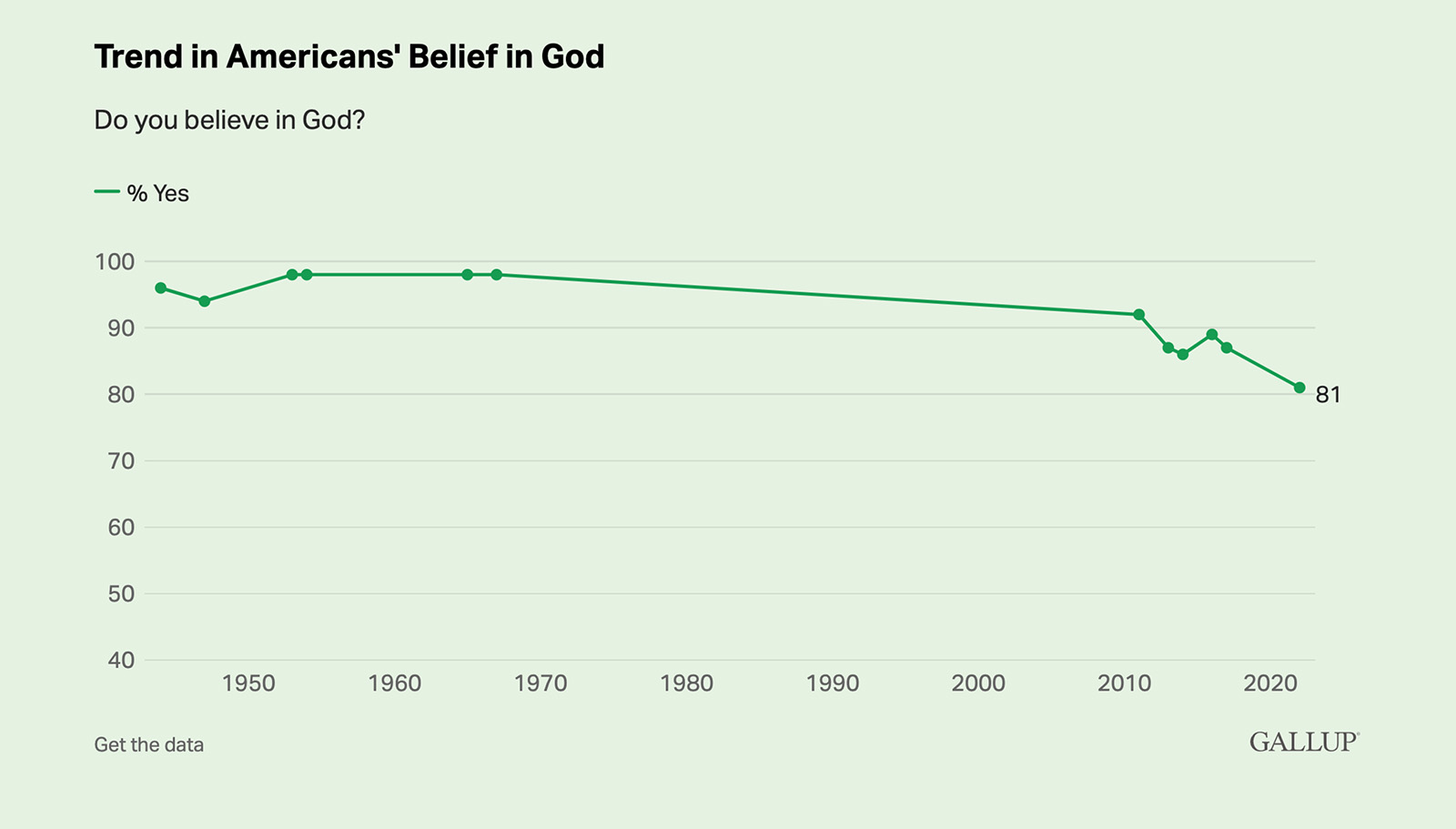
"In the latest Gallup Poll, belief in God dipped to 81%, down 6 percentage points from 2017, and the lowest since Gallup first asked the question in 1944."

"Throughout the post-World War II era, an overwhelming 98% of U.S. adults said they believed in God. That began to fall in 2011, when 92% of Americans said they believed in God and, in 2013, went down again to 87%."

"About 29% of Americans are religious “nones” — people who describe themselves as atheists, agnostics or “nothing in particular” when asked about their religious identity."

"belief in God has fallen most among younger Americans. Only 68% of adults ages 18-29 said they believed in God (compared with 87% of Americans age 65 or older.)"

"The poll found that 72% of self-identified Democrats said they believed in God, compared with 92% of Republicans (with independents in between at 81%)."

"Trend in Americans' Belief in God" Graphic courtesy Gallup

See Young Adults Tend to Stay Close to the Nest by Rina Torchinsky of The WSJ. Excerpts:

"80% of young adults at age 26 had moved less than 100 miles of where they grew up, and just 10% moved more than 500 miles away."

"Young adults raised in higher-income families moved farther than those who were raised in lower-income families, the paper shows."

"At age 26, Asians were living an average of around 220 miles from where they grew up; whites, 190 miles; Hispanics, 140 miles; and Blacks, 130 miles away"

"Researchers estimate that if wages in a given commuting zone increased by roughly $1,600 annually or about 80 cents per hour, 99% of the wage gains would reach residents who would have lived there anyway if there wasn’t a wage increase."

See Americans Are Breaking Up With Their Work Friends by Lindsay Ellis of The WSJ. Excerpts:

"The role of workplace friendships is now getting a big test, as companies seek to rebuild office cultures with many of their employees still remote part of the time. Among nearly 4,000 hybrid workers surveyed by Gallup in June, 17% said they had a “best friend” at work, down from 22% who said they did in 2019. For all workers, including those fully remote or on-site, the share who reported a close work friend slipped less, to 19% from 20%.

Meanwhile, the data suggests the link between having a best work friend and feeling committed to a job has grown stronger over the past three years—meaning, workers who don’t have one are more likely to want to leave. About 15% of people without a best friend at work reported being extremely satisfied at work this year, fewer than the 23% who said the same in 2019, according to Gallup, which has been surveying employees on their work friendships for more than two decades."

"The reliance on Zoom calls and other virtual forums at work has made cultivating and keeping up work friendships taxing for many people, said Julianna Pillemer, a professor at New York University’s Stern School of Business who has studied work relationships."

"Some employers are trying to help co-workers cultivate such bonds. This summer, KPMG brought its 2,800-person intern class to a lake house training facility in Orlando, Fla., complete with social venues, guest rooms and a gym. A spokesperson said the company hopes that the in-person socializing and networking will help many interns ultimately accept full-time job offers from the accounting firm."

See Life Expectancy in the U.S. Fell Again in 2021 as Covid, Overdoses Took Toll by Julie Wernau of The WSJ. Excerpts:

"Life expectancy in the U.S. dropped in 2021 for a second consecutive year as Covid-19 and overdoses drove up mortality rates, preliminary data showed.

Americans’ life expectancy last year fell 0.9 year on average to 76.1 years, according to data from the Centers for Disease Control and Prevention released Wednesday. It was a smaller drop than in 2020, when life expectancy decreased 1.8 years, the data showed, but the combined figures for the two years were the largest since the 1920s, the CDC said."

"The data demonstrated that some groups have been hit particularly hard by the pandemic as well as the opioid crisis, which claimed some 108,000 lives last year. Indigenous Americans had the biggest drop in life expectancy in 2021 at 1.9 years, the data showed, bringing their life expectancy to 65.2 years, down 6.6 years since 2019."

"Life expectancy declined less among Black people than white people in 2021, the data showed, reflecting in part the higher burden of deaths among some minority groups in the early phases of the pandemic. Black people in the U.S. had a life expectancy of 70.8 years last year, according to the CDC, compared with 76.4 years for white people.

“We continue to see disparities for people of color,” said Ada Stewart, a family physician with Cooperative Health in Columbia, S.C., and board chair of the American Academy of Family Physicians. “They did not fare well during the pandemic.”"

Monday, September 05, 2022

Gross domestic income, an alternative to gross domestic product as a measure of output, points to a stall instead of a recession

See A Different Take on the U.S. Economy: Maybe It Isn’t Really Shrinking by Jon Hilsenrath of The WSJ. Excerpts: Excerpts: 

"When the Commerce Department reported last month that U.S. economic output contracted for two consecutive quarters during the first half of the year, it raised fears the U.S. might be in recession, defined in a popular rule of thumb as two negative quarters of growth. New data sends a different message: rather than in recession, the economy might be in something closer to a stall.

Economic output can be measured two different ways: gross domestic product, or gross domestic income. For every dollar an individual spends to buy some good or service—a restaurant meal, a car, a doctor’s visit—another individual earns a dollar of income to make and deliver that good or service. GDP captures the spending side of these transactions, GDI the income side.

In theory, GDI and GDP should equal each other, though there is always some statistical discrepancy because they are measured using different data sets and different sources. This year the discrepancy has been unusually large. During the first half of the year GDP contracted at a 1.1% annual rate, adjusted for inflation. At the same time, GDI, made up of a measure of corporate profits, wages and benefits, self-employment income, interest and rent, expanded at a 1.6% annual rate, the Commerce Department reported Thursday."

"Some economists look for a clearer picture by averaging GDP and GDI. That measure of output barely moved at all, rising at a 0.2% annual rate, adjusted for inflation, over the first six months of the year. This is more consistent with a stalling economy than one in recession.

“The economy is stagnating, but it’s not declining,” said Robert Gordon, a Northwestern University professor and longstanding member of a committee at the National Bureau of Economic Research, which dates the beginning and end of recessions."

"Some studies have shown that GDI might be a more reliable real-time gauge of activity than GDP. In a 2010 study, Jeremy Nalewaik, then a Federal Reserve economist, found that GDP tended to be revised toward income measures over time. If this year follows the pattern, the GDP contraction might be revised away in the years ahead."

Sunday, September 04, 2022

Students at Cornell University can use an app to pay their peers to drop out of certain classes to obtain an open seat themselves

See Pollinate: The Academic Advocacy Service That Has Cornell Abuzz by Mary Sotiryadis of The Cornell Daily Sun

This seems a little bit like ticket scalping. You buy a concert ticket (maybe after waiting in line at a ticket office in the old days). Then you re-sell it to someone else for a higher price. This might mean that they are paying your for your time. If their time is more valuable than yours, this could actually be an efficient way to do things. If the price Cornell charged for each class were higher, then this would not happen.

Excerpts from the article:

"In the weeks before the fall 2022 semester, social media was abuzz with rumors of a new online service called Pollinate that allows students to pay their peers to drop out of certain classes to obtain an open seat themselves — now Pollinate has landed at Cornell. Students took to Sidechat and Reddit with complaints of classism and elitism.

Despite Pollinate’s increasing presence on campus, it was actually founded at the University of Chicago by two seniors, Jon Merril and Jack Ogle, studying economics. 

“We focused on Cornell because we had friends who go to Cornell, and we heard that [enrollment in specific courses] was a problem there as well,” Merril said.

"Some students raise a concern that the software is perpetuating elitism by allowing financially privileged students to buy seats from disadvantaged students. 

Muna Mohamed ’24 said that she would never use Pollinate because the prices are too high and she is worried about how it affects her own ability to get into the classes she needs to graduate.

“No student is going to drop a class without some monetary incentive, so the advocacy thing is basically null,” Mohamed said. “This just encourages students to take up spaces in classes and keep them until they can get paid for it, even if they don’t need it. This does nothing but make class registration harder than it already is.”"

Related post:

Want to make $60 an hour? Stand in line for a lobbyist, while its still legal (2007)

Here is that short post:

Lobbyists in Washington are very busy and their time is valuable. So they don't want to wait in line to get a good seat at a Congressional hearing. So they pay people to stand in line for them. Companies exist to find waiters and the internet is used. You can make up to $60 an hour. Seems okay to me. Lobbyists can use their time wisely and low income people can earn alot. But a senator wants to outlaw the practice. It was in today's San Antonio Express-News. The article is
Waiting for dollars won't hurt America and was by Maria Anglin (unfortunately, the article by Ms. Anglin is no longer online).

Friday, September 02, 2022

The percentage of 25-54 year-olds employed rose in August

One weakness of the unemployment rate is that if people drop out of the labor force they cannot be counted as an unemployed person and the unemployment rate goes down. They are no longer actively seeking work and it might be because they are discouraged workers. The lower unemployment rate can be misleading in this case. People dropping out of the labor force might indicate a weak labor market.

We could look at the employment to population ratio instead, since that includes those not in the labor force. But that includes everyone over 16 and that means that senior citizens are in the group but many of them have retired. The more that retire, the lower this ratio would be and that might be misleading. It would not necessarily mean the labor market is weak.

But we have this ratio for people age 25-54 (which also eliminates many college age people who might not be looking for work).

The percentage of 25-54 year olds employed was 80.3% in August. It was 80.0% in July. 

It was 80.5% in Jan. 2020 and 69.6% in April 2020.  Click here to see the BLS data. The unemployment rate was 3.7% in August. Click here to go to that data. The % of those 16 and older employed went from 59.96% in July to 60.08% in August.

Here is a good graph from the St. Louis Fed. It shows that there are 127,149,000 people in the 25-54 year old group. So since we are 0.2 percentage point below the 80.5% of Jan. 2020 (the high point since the previous recession), that is still 254,298 fewer jobs (Hat tip: Vance Ginn of the Texas Public Policy Foundation). 

Also, we are up 10.7 percentage points since April 2020 (80.3 - 69.6). That is 98.2% of what we lost from Jan. 2020 to April 2020 (10.9 percentage points or 80.5 - 69.6). Then 10.7/10.9 = 98.2%. So we have gotten about 98.2% of the jobs back.  

Here is the timeline graph of the percentage of 25-54 year olds employed since 2012.


Now since 1948 

Thursday, September 01, 2022

Beat the Market by Picking the Market

Stock funds have been pulling a switcheroo to make their returns look better: When they don’t measure up, they change how they measure 

See How to Beat the Stock Market Without Even Lying by Jason Zweig of The WSJ. Excerpts:

"You know all that stuff you’ve been hearing for so long about how fund managers can’t beat the market?

It isn’t true. Fund managers can easily beat the market. All they have to do is change which market they’re trying to beat.

Hundreds of them have been doing just that for years. Such maneuvers are perfectly legal—and investors need to fend for themselves, because regulators have so far been paying little attention.

A new study by finance professors Kevin Mullally of the University of Central Florida and Andrea Rossi of the University of Arizona finds that between 2006 and 2018, 37% of all U.S. stock mutual funds pulled this kind of switcheroo.

In as many as two-thirds of the cases, funds made past returns look better by changing the benchmarks they compared themselves to. More than half the time, funds chose a new index that wasn’t even a good match for their strategy.

Note carefully: Funds can’t retrospectively change their results, but they can switch what they compare those results to."

"Determining which index is appropriate is more or less up to the manager. Fund companies can change benchmarks without much explanation."

"On average, according to Profs. Mullally and Rossi, by switching indexes, fund managers make their past returns—relative to “the market”—look 0.8 percentage point better over one-year periods. Longer-term results get an even bigger boost, rising by an average of 2.4 and 4.8 percentage points, averaged annually, over five and 10 years, respectively."

"Prospectuses always warn that past performance is no guarantee of future results. Turns out it’s no guarantee of past results, either."

See also Efficient Market Hypothesis (EMH) by Lucas Downey of Investopedia. Excerpt:

"The efficient market hypothesis (EMH), alternatively known as the efficient market theory, is a hypothesis that states that share prices reflect all information and consistent alpha generation is impossible.1

According to the EMH, stocks always trade at their fair value on exchanges, making it impossible for investors to purchase undervalued stocks or sell stocks for inflated prices.1 Therefore, it should be impossible to outperform the overall market through expert stock selection or market timing, and the only way an investor can obtain higher returns is by purchasing riskier investments." 

The book The Armchair Economist by Steven Landsburg says, based on research by Lauren Feinstone done in 1987, that "all new information about an asset is fully incorporated into the price within 30 seconds of its arrival."